
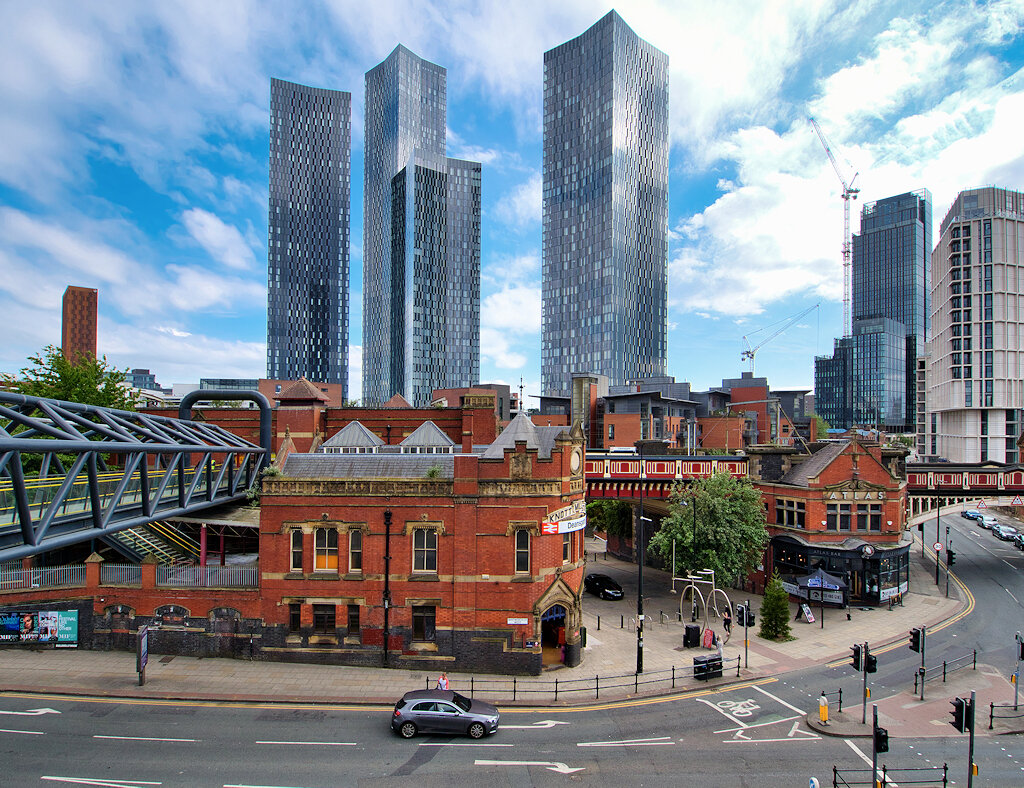
Manchester and the Industrial Cities of Britain
The great industrial cities of Britain, with Manchester at their head, were the most visible symbols of the Industrial Revolution. These cities grew rapidly, from small market towns into major industrial centers, in the space of a few decades, and they became the model, or warning, for cities around the world.
The Growth of the Industrial Cities
The British Industrial Revolution produced a new kind of city, the industrial city, in which the majority of the population was employed in manufacturing, mining, or related services. These cities grew rapidly, often at rates of several percent a year, and they became some of the largest and most dynamic urban centers in the world. The most important industrial cities of Britain were Manchester, Birmingham, Leeds, Sheffield, Glasgow, Liverpool, and Bristol. Each of these cities developed its own specialty industries, but they shared many features: rapid growth, overcrowded housing, pollution, and a new industrial working class.
Manchester: The First Industrial City
Manchester was the first large industrial city in the world, and it became the model for all the others. The city’s growth was driven by the cotton industry, which had its center in Manchester and the surrounding towns of Lancashire. The article on Cottonopolis and the Manchester cotton industry describes the development of the cotton industry in Manchester in more detail. The article on the Manchester Ship Canal describes the major infrastructure project that helped to make Manchester a great inland port.
Birmingham: The City of a Thousand Trades
Birmingham was the second great industrial city of Britain, and it was known as the “City of a Thousand Trades” for the diversity of its industries. Unlike Manchester, which was dominated by the cotton industry, Birmingham had a wide range of metalworking, engineering, and other industries.
Leeds, Sheffield, and Glasgow
Leeds, in the West Riding of Yorkshire, was the center of the British woolen industry. Sheffield, in South Yorkshire, was the center of the British steel and cutlery industry. Glasgow, on the River Clyde in Scotland, was the center of the Scottish industrial economy, and it grew rapidly in the late eighteenth and early nineteenth centuries.
Manchester by the Numbers, 1772-1901
The growth of Manchester over the long nineteenth century is the standard example of the industrial city. The population of Manchester township grew from 22,481 in 1773 to 142,526 in 1831, 303,382 in 1861, 505,368 in 1891, and 543,872 in 1901, a roughly 24-fold increase in 130 years. The cotton trade of the surrounding Lancashire region was by far the most important economic activity: by 1840, Lancashire had about 1,200 cotton mills running some 8 million spindles, more than half the world total. The value of cotton exports from Liverpool, the port that handled the trade, rose from £11.6 million in 1815 to £42.4 million in 1845. Manchester’s net rateable value — a rough measure of the taxable base of the city — grew from £89,000 in 1770 to £649,000 in 1830, an increase that funded the construction of the city’s commercial core. The Manchester Statistical Society, founded in 1833, began the systematic collection of social and economic data, much of it later published in the works of James Kay-Shuttleworth and Frederic Smith, and these data are the empirical basis for most of what we know about the early industrial city.
Engels and the Condition of the Working Class
The most influential single book on the industrial city is Friedrich Engels’ Die Lage der arbeitenden Klasse in England (1845), written when Engels was 24 and living in Manchester. Engels spent twenty-one months in the city, observing and interviewing workers in the Salford, Hulme, and Deansgate areas, and producing a study that combined statistical data, personal testimony, and socialist analysis. The book argued that the industrial city was not simply a site of poverty but a producer of it, and it located the source of working-class immiseration in the structure of industrial capitalism rather than in the character of the workers themselves. The book was largely untranslated into English until Florence Kelley’s 1887 American edition, but it was known in Manchester to Engels’s circle — Marx read the German text in 1845 — and it shaped the political interpretation of the new city for the next century. Engels’s account has been challenged in detail by later historians, particularly on the question of life expectancy, but the framework of the argument is still the starting point for the study of urban industrialism.
Public Health and the Manchester Sanitary Movement
Manchester’s response to its sanitary crisis is the prototype for British urban public health. The Manchester Statistical Society’s 1834 report on the sanitary condition of the laboring population, presented by James Kay (later Kay-Shuttleworth) to the British Association for the Advancement of Science, was a foundational text of the sanitary reform movement. Manchester established the first local Board of Health in 1794 (revived 1830) and one of the first in the country, and the city’s response to the cholera epidemic of 1832 was organized around the existing local machinery. The appointment of the first Medical Officer of Health in Liverpool, William Henry Duncan, in 1847, and the passage of the Public Health Act of 1848 by Edwin Chadwick, were directly influenced by the Manchester experience. The city’s mortality statistics, gathered continuously from 1841 by William Farr at the General Register Office, were the first systematic English data on the demographic costs of urban life, and they form the empirical basis of the McKeown thesis of the 1970s, which argued that the improvement of urban mortality after 1850 was primarily a result of better nutrition and reduced exposure to infection rather than medical advances.
The Anti-Corn Law League and the Rise of the Industrial Middle Class
Manchester was the home of the Anti-Corn Law League, founded in 1838 by Richard Cobden and John Bright, which became the first modern mass-political-pressure organization in Britain. The League spent roughly £100,000 per year by 1841, distributed tens of millions of pamphlets, and fielded 200 paid speakers to agitate for the repeal of the protective duties on imported grain. The repeal of the Corn Laws in 1846 and the subsequent commercial expansion of British industry were central to the political economy of the industrial city, and the League’s success prefigured the techniques of mass political organization later used by the Chartists and the trade unions. The Manchester School of political economy, associated with Cobden, Bright, and John Stuart Mill’s early writings, made the city a center of mid-nineteenth-century liberal thought.
The Manchester Ship Canal and the Decline of Cottonopolis
By the 1880s, the older cotton industry of central Manchester was in visible decline, and the city’s business community turned to public works to maintain its competitive position. The Manchester Ship Canal, opened on January 1, 1894, was at the time the largest civil engineering project in the world outside the United States, with a length of 36 miles, five locks, and a cost that ran from an estimated £5.75 million to a final total of £15 million. The canal made Manchester, which had been inland, into a “seaport” — the ninth-largest in the country by 1900 — and allowed the city to capture trade that had previously gone through Liverpool. But the canal could not reverse the underlying economic shift: by 1910, the British cotton industry had begun losing its world market to Japan, India, and the United States, and Manchester’s traditional spinning and weaving firms were either failing or being absorbed. The city’s population peaked at 766,311 in 1931, and the long decline of the cotton industry, analyzed by Peter N. Stearns in The British Workshop of the World (1972) and Stephen Marriner in The Transformation of the Cotton Trade, 1780-1840 (1970), was already apparent by 1900.
Historiography: The Industrial City in the Field
The interpretation of the British industrial city has been a major site of historical debate since the 1960s. The “Standard View” — that industrialization produced a deterioration of working-class life, including declining real wages, increased mortality, and the destruction of traditional communities — was challenged in the 1970s by the “Standard-of-Living Controversy,” which reached its peak at a 1979 Past and Present conference and in the exchanges between Maxine Berg, Peter Kirby, and Andrew Sheratt in the journal’s pages. The revisionist case, associated with R. M. Hartwell and with the cliometric work of Robert Fogel and Robert C. Allen, argued that the data on wages and health were better than the pessimists had supposed. The more recent literature, including Henry Mayhew’s London Labour and the London Poor (1851) and David Vincent’s Bread, Knowledge and Freedom (1981), has returned to the cultural rather than purely material aspects of working-class life and recovered a more nuanced picture in which the industrial city was both a site of deprivation and of unprecedented social, political, and religious experimentation.
Birmingham, the Workshop of the World
Birmingham, the second city of the British industrial economy, was a different kind of industrial city from Manchester. Manchester was dominated by the single industry of cotton; Birmingham had a diversified industrial base, with a wide range of metalworking, engineering, and consumer goods industries, and the city was known as the “City of a Thousand Trades” or the “Workshop of the World.” The principal Birmingham industries included brass and copper founding, jewelry, buttons, guns, screws, pins, pen nibs, jewelry, electroplating (the Elkington family, 1840s), and the manufacture of bicycles, automobiles, and aircraft (the Cadbury, Boulton and Watt firms of the Soho Manufactory, the Austin Motor Company founded 1906). The population of Birmingham grew from 23,000 in 1750 to 233,000 in 1851 and 522,000 in 1901. The Birmingham and Midland Institute (1854) and the Mason Science College (1875, the predecessor of the University of Birmingham) made the city an important center of adult education and scientific research, and the Birmingham Lunar Society — with Watt, Boulton, Josiah Wedgwood, Erasmus Darwin, and others — was the most influential scientific club of the late 18th century. The history of Birmingham is the subject of Carl Chinn’s Birmingham Working People (1975) and of Eric Hopkins’s Birmingham: The Making of the Second City, 1850-1939 (2001).
The Manchester-Salford Conurbation
Manchester and the adjacent borough of Salford formed a single conurbation of about 700,000 people by 1900, with a population density of 30,000 per square mile in the central districts. The two cities were joined by a network of bridges across the Irwell, including the famous Blackfriars Bridge of 1820, and the Manchester Ship Canal of 1894, which connected the two cities to the sea. The principal industries of the conurbation were cotton, engineering, chemicals, and the service industries of the central business district. The Manchester Town Hall of 1877, designed by Alfred Waterhouse, was the symbol of the civic pride of the new industrial city. The city’s political culture was dominated by the Manchester School of political economy and by the Liberal Party, with the Manchester Liberal Federation of 1868 the first organized city Liberal Party in Britain. The Manchester Guardian (founded 1821, renamed The Guardian in 1959) was the principal newspaper of the conurbation, and the Manchester Athenaeum of 1836 was the principal cultural institution. The Manchester-Salford conurbation is the subject of John Rylands Library studies and of Alan Kidd’s Manchester: A History (2006).
The Leeds, Sheffield, and Glasgow Industries
The other principal industrial cities of Britain had their own distinctive character. Leeds, the second largest city in the West Riding of Yorkshire, was the commercial center of the British woolen industry, with a population that grew from 25,000 in 1770 to 53,162 in 1831 and 259,201 in 1891. The principal Leeds industries were the worsted trade, the flax and linen trade, and the ready-made clothing trade, and the city was a major center of the ready-made clothing industry in the late 19th century. Sheffield, in South Yorkshire, was the center of the British steel and cutlery industry, with a population that grew from 14,000 in 1750 to 91,692 in 1851 and 284,410 in 1901. The principal Sheffield industries were the steel and cutlery trade, the silver trade, and the plate-glass trade, and the city was the home of the Sheffield plate and the stainless steel industries. Glasgow, on the River Clyde in Scotland, was the commercial center of the Scottish industrial economy, with a population that grew from 28,000 in 1750 to 274,533 in 1851 and 564,878 in 1901. The principal Glasgow industries were the cotton trade, the tobacco trade, the shipbuilding trade, and the engineering trade, and the city was the home of the Clyde-built ship industry and the Caledonian Railway. The history of these three cities is the subject of Gordon Jackson’s Huddersfield: A Most Handsome Town (1998) and of Andrew Gibb’s Glasgow: The Making of a City (1983).
The Post-Industrial Decline and Recovery
The British industrial cities of the 19th century have had very different fates in the post-1945 period. Manchester, Birmingham, Leeds, and Glasgow all suffered from the loss of the older heavy industries — cotton, steel, shipbuilding, engineering — and from the suburbanization of the middle class. Manchester’s population peaked at 766,311 in 1931 and fell to 392,830 in 2001 before recovering slightly to 553,230 by 2021. Birmingham’s population peaked at 1,114,000 in 1939 and fell to 977,000 in 2001 before recovering. Glasgow’s population peaked at 1,088,000 in 1939 and fell to 577,000 in 2001 before recovering slightly. The 1980s were particularly difficult, with the Miners’ Strike of 1984-1985 and the closure of many of the older manufacturing firms. The post-industrial recovery has been driven by the service sector, the universities, the cultural industries, and the new media and digital firms. The BBC’s move to Salford in 2011 and the development of the MediaCityUK on the Manchester Ship Canal were major steps in the recovery. The history of the post-industrial city is the subject of H. J. Dyos’s The Victorian City (1973) and of the Centre for Urban History’s studies. The Manchester case is, in many ways, a model of the kind of urban transformation that other post-industrial cities around the world are now undergoing.
Suggested Reading
The principal works on the British industrial cities include Friedrich Engels’s The Condition of the Working Class in England (1845), T. S. Ashton’s The Industrial Revolution, 1760-1830 (1948), and J. H. Clapham’s An Economic History of Modern Britain (1930). For Manchester, see Alan Kidd’s Manchester: A History (2006). For Birmingham, see Carl Chinn’s Birmingham Working People (1975) and Eric Hopkins’s Birmingham: The Making of the Second City (2001). For the public health movement, see Anthony S. Wohl’s Endangered Lives (1983) and Christopher Hamlin’s Public Health and Social Justice in the Age of Chadwick (1998). The Manchester Statistical Society’s Transactions and the Economic History Review are the principal sources for the early industrial city.
Key Dates in the Industrial Cities
A short chronology of the principal dates in the history of the British industrial cities:
- 1761 — Bridgewater Canal opens
- 1772 — Manchester population about 25,000
- 1830 — Liverpool and Manchester Railway opens
- 1831 — Manchester population reaches 142,526
- 1842 — Manchester Statistical Society founded; Engels arrives in Manchester
- 1845 — Manchester population 250,000
- 1847 — Ten Hours Act
- 1851 — Manchester population 303,382
- 1885 — Manchester Ship Canal project begins
- 1894 — Manchester Ship Canal opens
- 1901 — Manchester population 543,872
- 1931 — Manchester population peaks at 766,311
- 1960s-1980s — Decline of the older industries
- 2011 — BBC moves to Salford Quays
See also
- Cottonopolis and the Manchester cotton industry
- Manchester Ship Canal
- overview of the British Industrial Revolution
- overview of the Industrial Revolution