
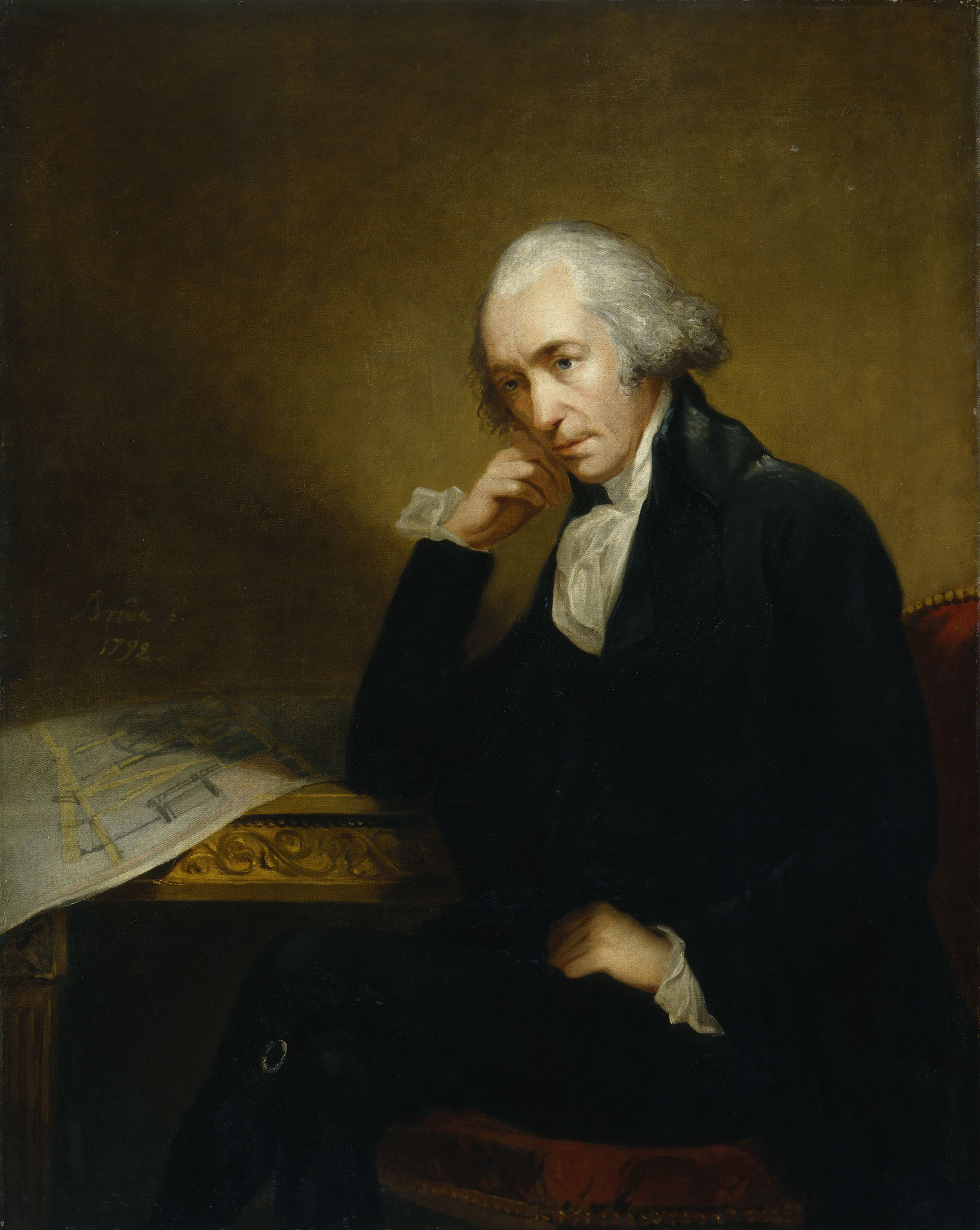
James Watt’s Improvements to the Steam Engine
James Watt’s improvements to the steam engine, developed between 1765 and 1782, are widely regarded as the most important single advance in the history of industrial technology. By developing the separate condenser, the double-acting cylinder, the centrifugal governor, the pressure gauge, and the indicator, Watt transformed the steam engine from a clumsy and inefficient pump into a reliable, efficient, and flexible source of power suitable for factories, mills, mines, and eventually railways and ships. His partnership with the Birmingham manufacturer Matthew Boulton produced a working engine in 1776, and by 1800 Boulton and Watt had built several hundred engines that became the standard power source of British industry.
The Problem of the Newcomen Engine
When Watt began his work in the 1760s, the Newcomen atmospheric engine had been in use for half a century. The Newcomen engine worked: a few hundred of them were pumping water from Cornish, Midlands, and Northeast coal mines by 1735. The problem was that it was extremely inefficient.
The standard measure of an eighteenth-century engine’s efficiency is the duty — how many pounds of water it can lift one foot high for each bushel (about 84 lb) of coal. John Smeaton’s carefully conducted tests of 1772–75 established the typical duty of an improved Newcomen engine at about 5.9 million foot-pounds per bushel of coal. A good Newcomen engine therefore consumed something like a third of a bushel of coal to lift one ton of water 100 feet. This was acceptable in the coal-mining regions of Cornwall and the Northeast, where coal was cheap, but it was uneconomic almost everywhere else.
The source of the inefficiency, Watt would later understand, was that the Newcomen engine repeatedly heated and cooled the same working cylinder: live steam was admitted to drive the piston up, then a jet of cold water was injected to condense the steam and bring the piston down, and the cycle was repeated. Each cycle therefore wasted enormous amounts of heat, because the metal of the cylinder had to be reheated to steam temperature before the next stroke could begin.
The Crucial Role of Latent Heat
Watt’s invention of the separate condenser is incomprehensible without the science of latent heat that had been worked out by the Scottish chemist Joseph Black in the early 1760s. Black had shown that a fixed amount of heat — the “latent heat” of vaporisation — is required to turn water at 100°C into steam at 100°C, and that the same amount of heat is given up when steam condenses back to water. The latent heat of vaporisation of water is about 2,260 kJ/kg — nearly six times the energy required to heat the same kilogram of water from 0°C to 100°C.
Black did not publish a formal treatise on latent heat, but he taught it at Edinburgh and Glasgow from 1761 onwards. Watt, who had been working as an instrument-maker at the University of Glasgow, was one of the small number of people to whom Black’s lectures were available; he and Black discussed the problem of the Newcomen engine in person. The separate condenser is in effect a mechanical application of the latent-heat concept: if the latent heat of condensation is what one needs to remove to make the steam condense, then the working cylinder should not be the place where one removes it, because that wastes the heat of the metal cylinder itself. A separate vessel, kept cool, should be used to condense the steam, leaving the working cylinder permanently hot.
This is one of the most important moments in the history of applied science. The Watt engine is the first large-scale industrial device in which an abstract piece of physical theory (latent heat) and a piece of practical engineering (the separate condenser) were made to fit together in a single working machine.
The Repair of the Newcomen Model and the First Patent
Watt’s breakthrough came in May 1765, on the Green, Glasgow, while walking to a meeting. He had been asked by the professor of natural philosophy John Anderson to repair a small Newcomen engine model belonging to the university, and his realisation of the relevance of Black’s latent-heat concept led him to the idea of the separate condenser. The first patent (the famous “separate condenser” patent) was granted in January 1769.
Watt’s first attempt to build a full-scale engine was a commercial failure. He had a difficult seven-year partnership with the ironmaster Dr John Roebuck of the Carron Company (1767–1773), during which Roebuck provided the capital and Watt provided the technical work; the experiment failed because the technology of metal-boring and cylinder-grinding was not yet good enough to make cylinders truly cylindrical, and the resulting leakage of steam from the piston undid the gain. The first successful engines were built only after Watt entered into a new partnership with Matthew Boulton of Birmingham in 1775.
The Partnership with Boulton
Boulton had the Soho Manufactory in Birmingham, a large purpose-built factory (opened 1761) with the best boring and grinding machinery in Britain, and the working capital to underwrite the long development cycle. Watt had the patents, the technical drawings, and the experimental record.
The first working Boulton and Watt engine was installed in 1776 at John Wilkinson’s New Willey ironworks at Broseley, Shropshire — not at Soho, although it was of course manufactured at Soho. (Wilkinson, who supplied the cast-iron cylinder, is sometimes called “the father of the iron steamship” and was Boulton and Watt’s first big customer.) The 1776 engine was a “fire engine” — a reciprocating pump of the traditional kind, suitable for draining mines. From 1782, with the expiry of the Boulton and Watt patent, the firm began to sell the new “rotative” engine (with the sun-and-planet gear) suitable for driving factory machinery.
The partnership with Boulton was both a technical and a financial innovation. Boulton and Watt sold the new engines on a premium-lease basis: the firm supplied the engine for a fixed annual fee, the fee being a fraction of the savings in coal compared with a Newcomen engine, and the fee running for a period of years (the 25 years of the extended 1775 patent). This was a sophisticated piece of business engineering that made the new technology affordable to most mines and to many mill owners. The firm of Boulton and Watt became, in the 1780s and 1790s, the most important engineering company in the world.
The Innovations, 1781–1784
Watt continued to work on the engine, and a series of later patents added the features that made it a general-purpose prime mover:
- The 1781 patent (the “sun-and-planet patent”) added the sun-and-planet gear that converted reciprocating into rotary motion — the crucial step that made the engine suitable for driving factory machinery.
- The 1782 patent (the “universal patent”) added the double-acting cylinder, the parallel motion linkage, the centrifugal governor, the throttle valve, the pressure gauge, and the automated fire-door — the basic set of features of a modern stationary steam engine. The same patent extended Boulton and Watt’s monopoly until 1800.
- The 1784 patent added the more efficient use of waste steam, an attempt to drive the piston by the expansion of high-pressure steam in a single cylinder.
- The indicator (a small steam-driven piston that drew a graph of pressure in the cylinder on a moving paper) was developed in the 1780s by Watt in collaboration with his assistant John Southern; it is the most important single instrument in the history of practical engineering, because it made it possible to measure the actual performance of a working engine, and to compare one engine with another. The indicator is still in use.
The combination of these innovations made the Watt engine a power source suitable for almost any industrial application. By 1800 the firm had sold several hundred engines (a number usually given as 451, from the Boulton and Watt letter-books). They were particularly common in the coal mines of Cornwall, the West Midlands, the Northeast, and South Wales, in the iron and brass works of Birmingham and Sheffield, and in the cotton-spinning and weaving mills of Lancashire.
Watt and the Science of Thermodynamics
Watt’s work on the steam engine produced one of the first large bodies of quantitative engineering data. The indicator, and the duty tests of Boulton and Watt’s engineer John Southern (Watt’s son-in-law) and the Cornish engine-minder Samuel Grose, generated the data on which the science of thermodynamics would eventually be built. The next steps came in the 1820s: Sadi Carnot’s Réflexions sur la puissance motrice du feu (1824) framed the second law of thermodynamics; William Rankine, Rudolf Clausius, and William Thomson (Lord Kelvin) completed the formal theory in the 1850s and 1860s. The high-pressure Cornish engine, built by Richard Trevithick in the early 1800s, was a separate line of development that bypassed Boulton and Watt’s low-pressure paradigm; it was Cornish engine efficiency, not Watt’s separate condenser, that produced the most fuel-efficient reciprocating steam engines of the nineteenth century.
The relationship between practical engineering and theoretical science, which Watt’s career exemplified, is one of the defining features of modern industrial technology. The great industrial research laboratories of the late nineteenth century, from Edison’s Menlo Park to the German chemical companies, were all in some sense following the model that Boulton and Watt had established in Birmingham in the 1770s and 1780s.
Watt’s Place in History
Watt died on 25 August 1819, at Heathfield Hall, near Birmingham, age 83, by which time the steam engine was the dominant source of industrial power in Britain, and his name had become synonymous with the new industrial age. The watt — the SI unit of power — is named after him, and his name is preserved in the names of streets, buildings, and institutions around the world. The Boulton and Watt rotative engine (1788) preserved in the Science Museum in London remains one of the most famous artifacts of the Industrial Revolution.
Watt’s importance goes beyond any particular invention. By demonstrating that a complex technology could be systematically improved through a combination of scientific theory and practical experiment, he helped to establish the modern idea of research and development. His partnership with Boulton, in which capital, manufacturing, and invention were combined in a single enterprise, was a model for the great industrial research laboratories of the late nineteenth and twentieth centuries.
What It Teaches Us
The open question about Watt is how much credit he deserves for the jump in engine efficiency between 1765 and 1800. The conventional answer, going back to Samuel Smiles and the Victorian hagiographers, is that Watt’s separate condenser was the breakthrough and the rest was detail. The revisionist answer, developed by Richard Hills in Power in the Industrial Revolution (1970) and by Terry Reynolds in Stronger than a Hundred Men (1983), is that the Newcomen engines of the 1730s and 1740s were already far more efficient than the standard textbook picture suggests, and that a substantial fraction of the fuel savings usually credited to Watt actually came from better boiler design, higher working pressures, and the use of expansion — improvements developed by the Boulton and Watt shop in the 1790s rather than in the 1769 patent. There is no clean resolution of this debate. The 1769 patent is real, the separate condenser is real, and the Cornish duty figures of the 1820s are the highest of any condensing engine ever built. The interesting question is what to make of the long middle period, when the engine was less a Watt-style scientific instrument and more a piece of community engineering.
Selected Sources
- Richard Hills, Power in the Industrial Revolution (Manchester University Press, 1970)
- Jenny Uglow, The Lunar Men: The Friends Who Made the Future, 1730–1810 (Faber and Faber, 2002)
- David Philip Miller, James Watt, Chemist (Pickering & Chatto, 2009)
- D. S. L. Cardwell, From Watt to Clausius (Heinemann, 1971)
- Thomas Kuhn, “Engineering Precedent for the Work of Sadi Carnot” (in The Structure of Scientific Revolutions, 3rd ed., University of Chicago Press, 1996)