
Thomas Newcomen and the First Practical Steam Engine
Thomas Newcomen (1664-1729) was the English inventor who built the first commercially successful steam engine. Working in the early years of the eighteenth century, Newcomen developed the atmospheric engine, a machine that used steam to drive a piston, and he installed the first working engine at a coal mine near Dudley Castle in 1712. Over the next half century, more than a hundred Newcomen engines were built in Britain and abroad, primarily to pump water out of coal and tin mines. Although Newcomen’s engine was eventually displaced by the more efficient engines developed by James Watt, it was the technology that made the steam engine a practical reality and laid the foundation for the steam-powered industrial world.
The Problem of Mine Drainage
To understand Newcomen’s contribution, it helps to understand the problem his engine was designed to solve. The British coal-mining industry, which had been growing rapidly in the seventeenth century, was increasingly hampered by water. As mines were dug deeper, water seeped into the workings from the surrounding rock, and the deeper mines were particularly prone to flooding. The traditional methods of pumping water, using horse-powered pumps or hand-worked buckets, were unable to keep up with the inflow, and many deeper seams of coal had to be abandoned.
The economic cost was significant, since coal was in growing demand for both domestic heating and industry. The problem was particularly acute in the coalfields of the West Midlands, the Northeast, and South Wales, where the geology made the deeper mines especially wet. The need for a more efficient pumping system was clear, and several inventors, including Thomas Savery and Denis Papin, had proposed steam-powered solutions. None had been successful, however, and it was Newcomen who finally produced an engine that worked.
Newcomen’s Engine
Thomas Newcomen was born in Dartmouth, Devon, in 1664, and was a Baptist lay preacher and ironmonger. He had no formal education in engineering, but he had practical experience with mining and machinery through his trade, and he was familiar with the attempts of earlier inventors to build a steam engine.
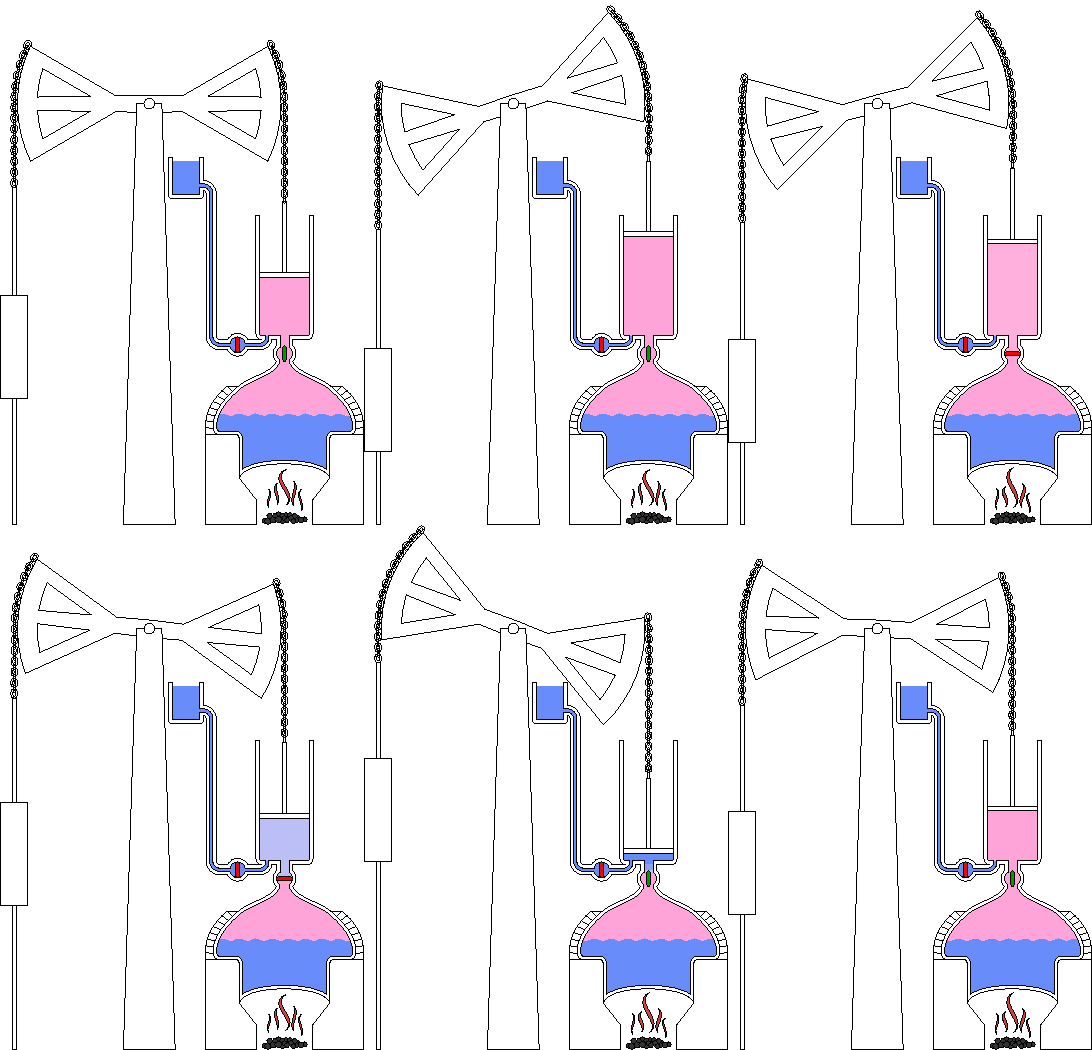
Newcomen’s first working engine was installed at a coal mine at Conygree, near Dudley Castle in the West Midlands, in 1712. The engine used steam to fill a large vertical cylinder, and then condensed the steam with a jet of cold water injected into the cylinder. The condensation created a partial vacuum inside the cylinder, and atmospheric pressure pushed the piston down. The piston was connected by a chain to a rocking beam above, which in turn drove a pump rod that lifted water out of the mine.
The atmospheric engine, as it was called, was a success. It could pump water from depths that would have been impossible with horse-powered pumps, and it was reliable enough to run continuously with relatively little maintenance. Within a few years, Newcomen engines were being installed in coal mines throughout Britain, and the technology was beginning to spread to continental Europe and to the American colonies.
The Spread of the Engine
Over the next half century, more than a hundred Newcomen engines were built in Britain and abroad. The engines were particularly common in the coalfields of the West Midlands, the Northeast, and South Wales, but they were also used in tin and copper mines in Cornwall, in lead mines in Derbyshire, and in a variety of industrial applications. A few were even used outside the mining industry, for example to supply water to towns and cities.
The Newcomen engine was a major improvement over the horse pumps it replaced, but it was not very efficient. The repeated heating and cooling of the cylinder wasted a great deal of heat, and the engine consumed large quantities of coal. A typical Newcomen engine might use several pounds of coal for every pound of water it lifted, and it was only economical in coal-mining regions where coal was cheap.
The Newcomen engine was also large and expensive, requiring a substantial building to house it and a team of workers to operate it. The cost of a Newcomen engine was several hundred pounds, and the engines were usually installed by groups of mine owners who pooled their resources.
Newcomen as an Inventor
Newcomen was a practical inventor rather than a theoretical scientist. He had no clear understanding of the physics of his engine, and he relied on trial and error to refine his designs. He was also a poor businessman, and he never made much money from his invention. The patents he obtained did not give him effective control over the use of the engine, and he was often paid only a fraction of what his engines were worth.
The story of Newcomen is in some ways a contrast to the story of his successor James Watt. Where Watt was a trained instrument maker with a deep understanding of the principles of his engine, Newcomen was a tinkerer who produced a workable machine by intuition and persistence. Where Watt was a skilled businessman who, in partnership with Matthew Boulton, made a fortune from his engines, Newcomen remained a relatively modest ironmonger.
Newcomen and Watt
The Newcomen engine dominated British industry for half a century, but it was eventually displaced by the more efficient engines developed by James Watt in the 1760s and 1770s. Watt’s separate condenser dramatically reduced the fuel consumption of the steam engine, and the partnership of Boulton and Watt built hundreds of engines that were both more efficient and more versatile than the Newcomen.
Despite this, Newcomen’s contribution was crucial. Without his engine, the coal mines of the early eighteenth century would have been unable to keep up with demand, and the industrial expansion of the late eighteenth century would have been much slower. The atmospheric engine, in other words, was a precondition for the Industrial Revolution, even though it was eventually replaced by a better design.
The Newcomen engine also played an important role in the development of the steam engine as a technology. By demonstrating that a steam engine could be built and operated commercially, Newcomen encouraged the next generation of inventors to try to improve his design. The Watt engine, in turn, was the basis for the high-pressure engines developed by Richard Trevithick and others, and these were the basis for the steam locomotives and steamships that transformed transportation in the nineteenth century. The article on James Watt’s improvements to the steam engine describes this next stage of the story.
Newcomen’s Legacy
Newcomen died in London in 1729, by which time the atmospheric engine was in widespread use but had not yet been recognized as one of the great inventions of the age. The famous claim that Newcomen “set the world on fire” was made only later, in the early nineteenth century, as the importance of the steam engine became clear. A statue of Newcomen was erected in Dartmouth in 1907, and the Newcomen Society, founded in 1920, is still a leading organization for the study of the history of engineering and technology.
The Newcomen engine is also important as a reminder that the Industrial Revolution was not the work of a single genius but of a succession of inventors, each building on the work of the last. Newcomen’s engine was not the first attempt to use steam for power, and it was not the last word in steam-engine design, but it was the first commercially successful steam engine, and it opened the door to a long line of improvements that would eventually transform the world.
The Continuing Question
How good was the Newcomen engine, really? The traditional picture, built on the work of L. T. C. Rolt and still common in textbooks, treats the Newcomen engine as a primitive device that Watt’s separate condenser swept away. The quantitative work of John Kanefsky and John Robey (“Steam Engines in 18th-Century Britain: A Quantitative Assessment,” Technology and Culture 21, 1980) used engine-by-engine survey data to show that Newcomen engines were steadily improved throughout their working life, and that by 1735 many were consuming under 5 pounds of coal per horse-power-hour — close to the thermodynamic ideal for an atmospheric engine of that design. Cornish engineers, in particular, pushed the duty figures (horse-power-hours per hundredweight of coal) to numbers that would not be bettered until the high-pressure engine of the 1820s. The unresolved question is how to weight Watt’s theoretical breakthrough against the Newcomen community’s incremental engineering. Both matter, and the standard story tends to give Watt too much credit and the Cornish engineers too little.
See also
Selected Sources
- L. T. C. Rolt, Thomas Newcomen: The Prehistory of the Steam Engine (1963).
- John Kanefsky and John Robey, “Steam Engines in 18th-Century Britain: A Quantitative Assessment,” Technology and Culture 21 (1980).
- T. S. Ashton, The Industrial Revolution, 1760-1830 (1948).
- Robert C. Allen, The British Industrial Revolution in Global Perspective (2009).