
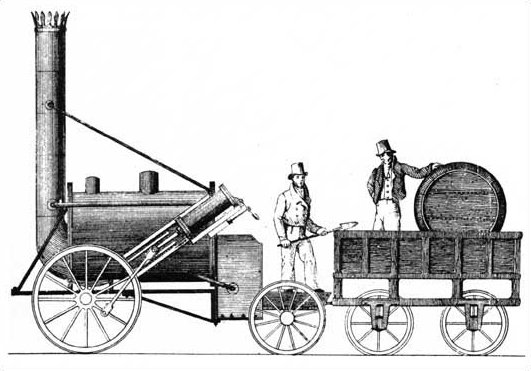
The Stephenson Rocket and the Rainhill Trials
The Rocket is the most famous steam locomotive in history. Designed by Robert Stephenson in 1829, the Rocket won the Rainhill Trials, a public competition to choose the locomotive for the new Liverpool and Manchester Railway, and it established the basic form of the steam locomotive for the next century. The Rocket is therefore one of the most important machines of the Industrial Revolution, and its design principles are still recognizable in steam locomotives today.
The Rainhill Trials
The Rainhill Trials were held in October 1829 on a level stretch of the Liverpool and Manchester Railway near the village of Rainhill. The Liverpool and Manchester Railway, then under construction, was the first major inter-city railway in the world, and the railway’s directors had decided to use steam traction rather than the horse-drawn or cable-hauled systems that had been used on earlier railways.
The directors organized a public competition to choose the locomotive for the railway. The trials were open to any locomotive that met certain requirements, including a maximum weight, a maximum cost, and the ability to haul a certain load at a certain speed. The winner would receive a contract to supply locomotives for the new railway, and the trials attracted entries from several leading engineers.
Ten locomotives were entered in the trials, although only five actually competed. The most serious competition came from the Novelty, designed by John Braithwaite and John Ericsson, which was lighter and more elegant than the Rocket. The Novelty set a new speed record during the trials, but it suffered from breakdowns and did not complete the required course. The Rocket, despite its simple and somewhat crude appearance, performed reliably throughout the trials, and it was declared the winner.
The Design of the Rocket
The Rocket was designed by Robert Stephenson, the son of George Stephenson, in collaboration with his father and the engineer Henry Booth. The locomotive was built in the Stephenson works at Newcastle upon Tyne in 1829, and it incorporated several innovative features that would become standard on later steam locomotives.
The most important of these features was the multi-tubular boiler. Earlier locomotive boilers had been simple cylindrical vessels, but the Rocket’s boiler had 25 fire-tubes running through it, which greatly increased the surface area exposed to the hot gases from the firebox. This, in turn, allowed the boiler to produce more steam, which made the locomotive more powerful. The multi-tubular boiler became a standard feature of steam locomotive design, and it remained in use until the end of the steam era.
A second important innovation was the blast pipe, a small pipe that exhausted the used steam from the cylinders up the chimney. The blast pipe created a draft that pulled the hot gases from the firebox through the boiler tubes, increasing the efficiency of the boiler. The blast pipe was a simple but effective idea, and it was adopted on virtually all subsequent steam locomotives.
A third innovation was the use of inclined cylinders to drive the wheels directly. Earlier locomotives had used a variety of mechanisms to transmit the power of the engine to the wheels, but the Rocket’s direct drive was simpler and more efficient. The inclined cylinder arrangement was eventually replaced by horizontal cylinders, but the principle of direct drive remained standard.
The Performance of the Rocket
The Rocket’s performance in the Rainhill Trials was impressive. It hauled a load of about 13 tons at speeds of up to 30 miles per hour, and it completed the required course without any major breakdowns. The Rocket’s top speed in the trials, about 36 miles per hour, was a new record for a steam locomotive.
The Rocket’s success was due in part to its design and in part to the skill of its driver, George Stephenson himself. Stephenson was an experienced locomotive driver, and he coaxed the best possible performance from the locomotive. The Rocket continued to run on the Liverpool and Manchester Railway for several years after the trials, and it was also used on other railways before being retired.
The Legacy of the Rocket
The Rocket established the basic form of the steam locomotive for the next century. The multi-tubular boiler, the blast pipe, and the use of adhesion rather than gears or chains became standard features of steam locomotive design, and they were refined and improved by the great locomotive builders of the late nineteenth and early twentieth centuries. The principles embodied in the Rocket can be seen in the famous locomotives of the golden age of steam, from Stephenson’s own later designs to the great express locomotives of the LNER and the Great Western Railway.
The Rocket is also important as a symbol. The image of the Rocket hauling a train at speed has become one of the iconic images of the Industrial Revolution, and the locomotive itself is preserved in the Science Museum in London, where it remains one of the most popular exhibits. The Rocket, with its black paint, its single tall chimney, and its exposed mechanical workings, is instantly recognizable, and it has come to represent the power and the promise of the new industrial age.
Stephenson’s Other Locomotives
The Rocket was not the only locomotive built by the Stephensons. The Stephenson works at Newcastle built many other locomotives in the 1830s and 1840s, and the Stephensons were involved in the design of the locomotives for many of the early British railways. Robert Stephenson in particular became one of the most respected engineers of his generation, and he was involved in the design of the Britannia Bridge and other major engineering works.
The success of the Rocket and the Liverpool and Manchester Railway transformed the career of George Stephenson, the illiterate son of a Wylam fireman who had been firing a Newcomen engine at the local pit since the age of eight. By the late 1830s Stephenson was the president of the Institution of Mechanical Engineers, the locomotive-building firm of Robert Stephenson and Company was the largest in the world, and the Liverpool and Manchester dividend of 1834 had been used to retire the last of the canal shareholders.
The Rocket and the Railway Age
The Rocket’s victory in the Rainhill Trials was a crucial step in the development of the railway. The Liverpool and Manchester Railway, which opened in 1830, demonstrated that a railway could be a successful commercial enterprise, and it triggered the great railway boom of the 1830s and 1840s. Within a generation, the railway had become the dominant form of long-distance transport in Britain, and the railway age was fully under way.
The Rocket’s design was also important for the global spread of the railway. The principles established by the Rocket, including the multi-tubular boiler and the blast pipe, were adopted by locomotive builders around the world, and the basic form of the steam locomotive remained remarkably consistent across the great railway systems of the world. The article on the railroad history describes the broader development of the British railway system.
What It Teaches Us
The Rainhill Trials of 6-14 October 1829 are the closest thing the Industrial Revolution has to a controlled engineering experiment, and they have been read in opposite ways ever since. The traditional reading, going back to L. T. C. Rolt’s The Railway Revolution (1962), is that the Rocket was the obvious winner: it was 12 tons, it had 13 mph average speed in the trials, and it beat Sans Pareil and Novelty (the latter retired with a broken cylinder) decisively. The revisionist reading, developed by Anthony Burton in The Locomotive Pioneers (1975) and given quantitative support by Michael Bailey in the Journal of the Railway and Canal Historical Society, is that the Rocket barely won — that it completed the 70-mile endurance test only after a wheelshaft repair, that the judges ran it on three runs and averaged the result, and that the actual performance difference between Rocket and Novelty (which was the fastest on its single completed run) was inside the noise of the test. The unresolved question is how to read engineering trials in general, and competition as a driver of technical progress. The same question recurs in the late 19th-century AC-vs-DC debate, in the Chrysler-versus-Cord-versus-Duesenberg styling wars of the 1930s, and in the early-2000s electric vehicle trials. The Rocket’s victory is real, but how decisive it was — and whether the Liverpool and Manchester board picked the right engine — is a question that historians still argue about.
See also
Selected Sources
- L. T. C. Rolt, The Railway Revolution: George and Robert Stephenson (1962).
- Jack Simmons, The Victorian Railway (1991).
- Michael Robbins, The Railway Age in Britain (1962).
- Anthony Burton, The Locomotive Pioneers (1975).