
Henry Ford and the Assembly Line
Henry Ford (1863-1947) was the American industrialist who founded the Ford Motor Company and developed the Model T, the first automobile to be mass-produced at a price that ordinary workers could afford. Ford is also famous for the development of the moving assembly line, a method of production in which the product moves past a series of workstations, with each worker performing a single task. The assembly line revolutionized manufacturing and made possible the mass production of a wide range of products, from automobiles to refrigerators to hamburgers.
Early Life and Mechanical Interests
Ford was born in 1863 in Dearborn, Michigan, the son of Irish immigrants. He grew up on a farm, but he had little interest in farming, and from an early age he was fascinated by machines. He taught himself to repair watches and clocks, and he built a small steam engine as a teenager. In 1879, he left the farm to take an apprenticeship as a machinist in Detroit, and he later worked for the Westinghouse Engine Company, where he gained experience with steam engines.
Ford’s interest turned to the internal combustion engine in the 1890s, and he built a series of experimental automobiles in his home workshop. In 1896, he completed his first car, the Quadricycle, which he drove through the streets of Detroit. The Quadricycle attracted the attention of the local press and of potential investors, and in 1899 Ford was invited to serve as chief engineer of the Detroit Automobile Company.
The Detroit Automobile Company did not prosper, and it was reorganized several times. Ford continued to work on his designs, and in 1903 he founded the Ford Motor Company with a group of investors. The new company initially produced a series of models, including the Model A and the Model C, but these were expensive and slow-selling. Ford needed a car that would appeal to a mass market, and he set out to design it.
The Model T
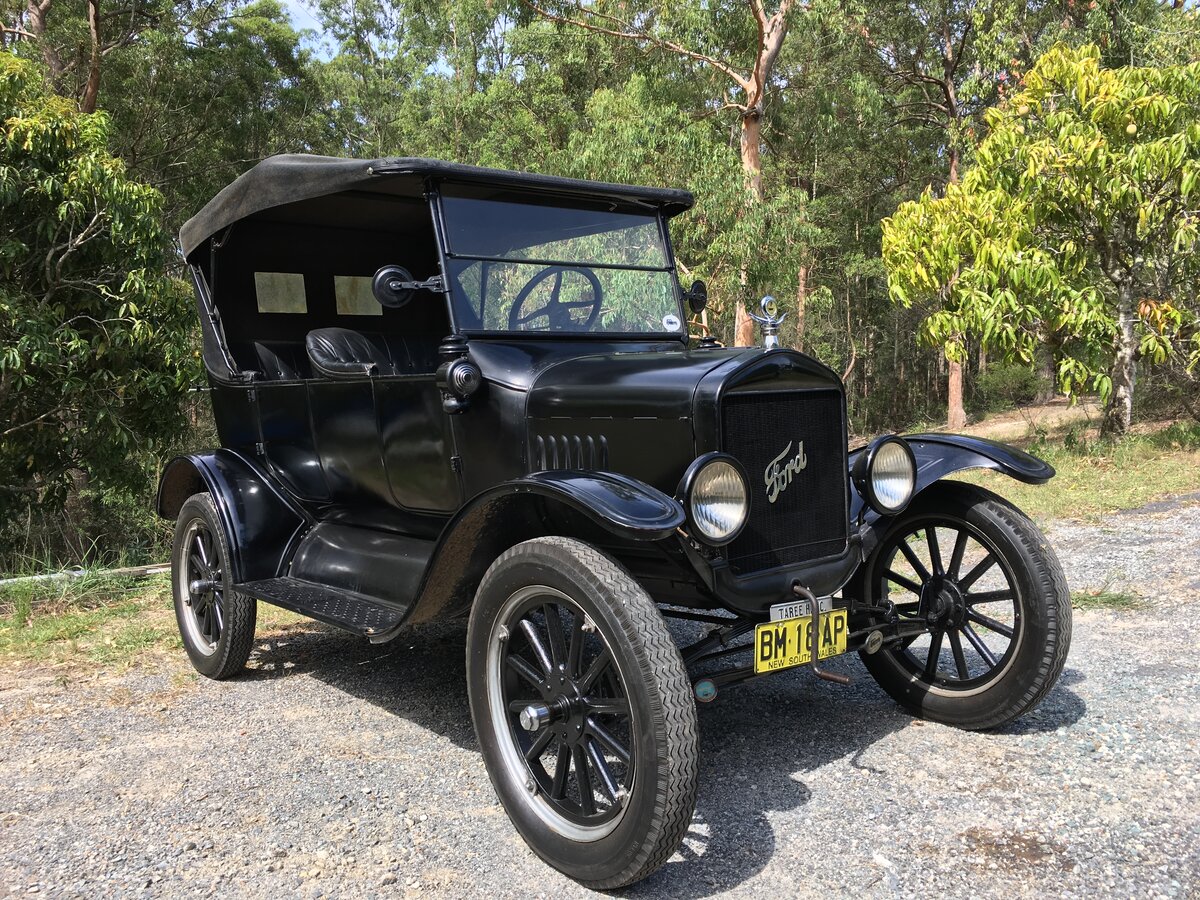
The result was the Model T, introduced in October 1908. The Model T was not the most technically advanced car of its day, but it was simple, reliable, and easy to repair. It could be driven on the rough roads of rural America, and it could be maintained by farmers and small-town mechanics. The article on the Model T Ford describes this important car in more detail.
The Model T was an immediate success. The Ford Motor Company could not produce them fast enough to meet the demand, and Ford and his engineers set out to develop a more efficient method of production. The result was the moving assembly line.
The Moving Assembly Line
The idea of the moving assembly line was not new, but Ford was the first to apply it to the production of a complex consumer product like the automobile. The first Ford assembly line was set up in 1913 at the Highland Park Plant in Michigan, and it was used to assemble the Model T’s magneto, a key component of the car’s electrical system. The new method dramatically reduced the time required to assemble a magneto, from about 20 minutes to about 5 minutes.
Encouraged by the success of the magneto line, Ford and his engineers set out to apply the same principles to the assembly of the entire car. In 1913 and 1914, they developed a moving assembly line for the complete car, in which the chassis was pulled along by a chain conveyor, with workers stationed at regular intervals performing specific tasks. The new method reduced the time required to assemble a Model T from about 12 hours to about 90 minutes, and the cost of the car fell dramatically.
The assembly line was a defining moment in the history of modern industry. By breaking the production process into a series of simple, repetitive tasks, Ford was able to employ less skilled workers and to produce more cars at a lower cost. The method was soon imitated by other automobile manufacturers, and it was eventually applied to a wide range of other products, from refrigerators to televisions to hamburgers.
The Five-Dollar Day
In January 1914, Ford announced a new wage policy that was as revolutionary as the assembly line. Ford offered his workers a “five-dollar day,” which was more than double the prevailing wage for similar work in Detroit. The five-dollar day was conditional on workers meeting certain standards of behavior, including sobriety, thrift, and marital fidelity, but it was a major innovation in industrial relations.
The five-dollar day had several purposes. It allowed Ford to attract and retain the best workers, and it reduced the high turnover that had plagued the automobile industry. It also created a mass market for the Model T, since Ford’s workers could now afford to buy the cars they were producing. The article on the causes of the Industrial Revolution describes the relationship between wages and consumer demand in more detail.
The five-dollar day was widely imitated by other American companies, and it helped to establish the idea that high wages and high productivity were complementary rather than contradictory. It also established Ford as a progressive employer, although his views on labor were often controversial, and his opposition to trade unions was strong and uncompromising.
Ford’s Later Career
Ford continued to lead the Ford Motor Company for many years, but his reputation became increasingly mixed. His resistance to the development of new models (he famously said that customers could have “any color they wanted, as long as it was black”) eventually allowed General Motors, founded by William Durant in 1908, to overtake Ford in the 1920s. His pacifist views during the First World War, and his later anti-Semitic statements, were widely criticized.
Despite these controversies, Ford’s legacy remains secure. He was one of the most important industrialists of the twentieth century, and his innovations, including the Model T, the moving assembly line, and the five-dollar day, transformed the American economy and the world. The Ford Foundation, established in 1936, became one of the largest philanthropic organizations in the world, and it continues to support a wide range of causes today.
Ford’s Place in History
Henry Ford died in 1947, by which time the Ford Motor Company was still one of the largest automobile manufacturers in the world, and his name had become synonymous with American industry. The Model T, which had been produced from 1908 to 1927, had been replaced by newer models, but the assembly line that Ford had pioneered remained the foundation of modern manufacturing.
Ford’s career illustrates several important features of the Second Industrial Revolution. It shows the role of individual entrepreneurs in shaping the new industrial economy, with Ford rising from a farm boy to one of the richest men in the world. It shows the importance of new technology, with Ford’s adoption of the internal combustion engine and the assembly line helping to make the automobile available to ordinary people. And it shows the new relationship between business and society, with Ford’s five-dollar day establishing a new model of high-wage, high-productivity industry.
The Continuing Question
The unresolved question about Ford is whether his mass-production system was as original as the standard story makes it. The traditional answer, going back to the 1924 Saturday Evening Post profile and given its modern form in Allan Nevins’s three-volume Ford (1954-1963), is that Ford invented the moving assembly line at Highland Park in 1913-1914, and that this invention, together with the five-dollar day, was the foundation of the modern consumer economy. The revisionist answer, developed in David Hounshell’s From the American System to Mass Production (1984), is closer to a community-of-engineers story: the assembly line as a concept went back to the Ransom Olds factory of 1901, the precision interchangeable-parts technology went back to the Springfield armory and to Henry Maudslay’s block-making machinery of the 1800s, and the moving conveyor went back to the meat-packing plants of Chicago and Cincinnati in the 1860s and 1870s. Ford’s contribution was the integration of these into a single production system, not the invention of any one component. The interesting current question, raised in the work of business historian Alfred Chandler and developed in the recent literature on lean production and post-Fordism, is whether the Ford system is still the right model for understanding 21st-century manufacturing. The Toyota Production System, lean production, and the rise of distributed manufacturing (3D printing, distributed small-batch production) all suggest that the Ford model of single-product high-volume assembly is no longer the default, and that the post-Ford economy is closer to flexible specialization.
See also
Selected Sources
- Allan Nevins, Ford: The Times, The Man, The Company (1954).
- David A. Hounshell, From the American System to Mass Production, 1800-1932 (1984).
- Stephen Meyer III, The Five Dollar Day: Labor Management and Social Control in the Ford Motor Company, 1908-1921 (1981).
- Robert H. Wiebe, The Search for Order, 1877-1920 (1967).