
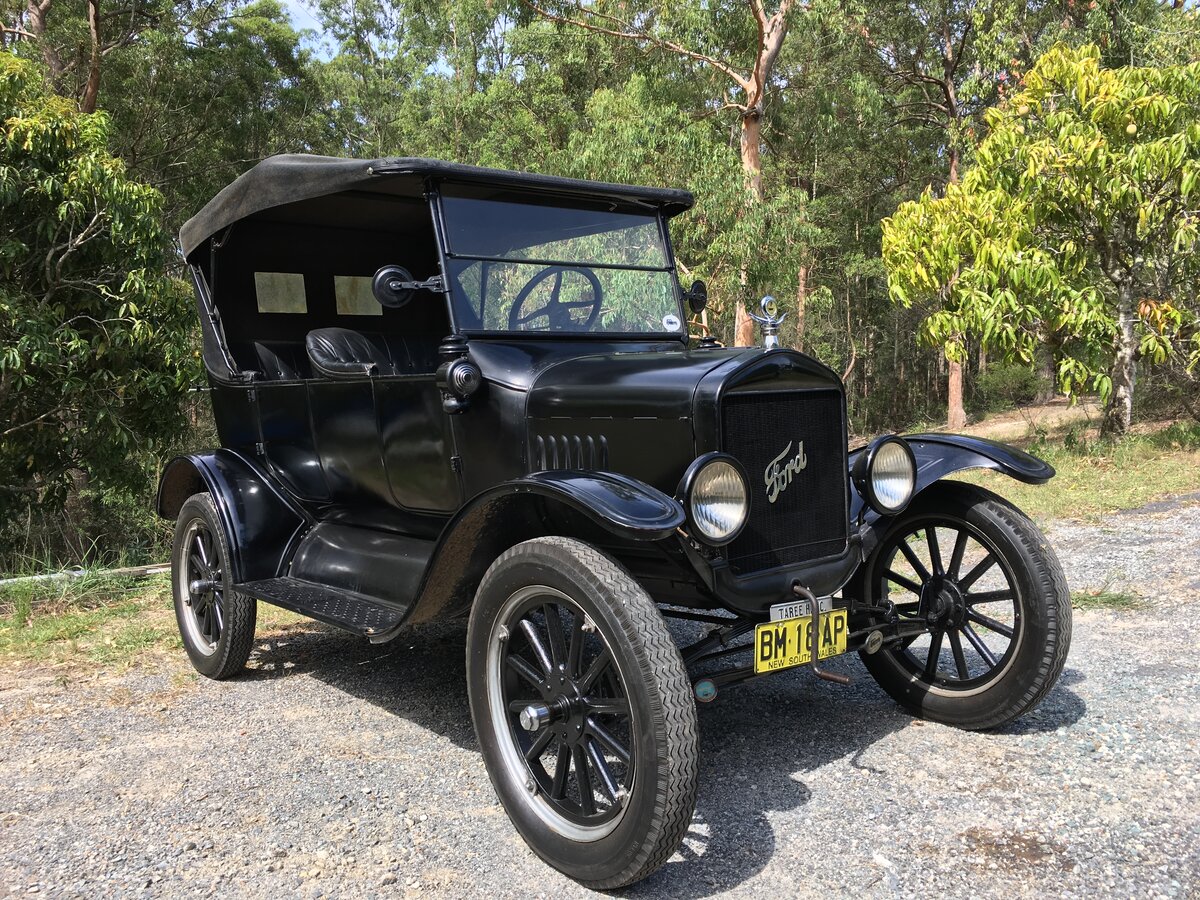
The Model T Ford: The Car That Put the World on Wheels
The Model T Ford, produced by the Ford Motor Company from 1908 to 1927, was the most successful automobile in history. Over 15 million Model Ts were sold, and the car transformed American society by making automobile ownership available to ordinary people for the first time. The Model T was also the car that was produced using Ford’s revolutionary moving assembly line, which made the mass production of complex consumer products possible.
The Design of the Model T
The Model T was designed by a team of engineers working under the direction of Henry Ford. The chief engineer was Childe Harold Wills, and other key members of the team included the Hungarian-American engineer Joseph A. Galamb. Ford’s design philosophy rested on the standardisation and interchangeability of parts, principles he set out in My Life and Work (1922) and which Nevins and Hill analyse in detail in Ford: Expansion and Challenge, 1915–1933. The car was intended to be simple, reliable, and affordable, and it was designed to be driven on the rough roads of rural America.
The Model T was a four-cylinder, 20-horsepower car with a top speed of about 45 miles per hour. It had a two-speed planetary transmission, which was easy to operate but not particularly efficient, and it used a hand-crank starter rather than the electric starters that became standard later. The body of the car was originally available in a single color, black, although earlier models were available in other colors. Ford famously remarked that the Model T could be ordered in any color, “as long as it was black.”
The Model T was also designed to be easy to repair. The engine was simple and accessible, and many of the components could be replaced with basic tools. This was particularly important in rural America, where mechanics and service stations were often far away, and where farmers and small-town mechanics often had to do their own repairs.
The Production of the Model T
The Model T was first produced in 1908 at the Ford Piquette Avenue Plant in Detroit. The car was an immediate success, and the demand soon outstripped the capacity of the Piquette Avenue Plant. In 1910, Ford moved production to a new, larger plant at Highland Park, Michigan, where he developed the moving assembly line.
The Highland Park Plant, designed by the architect Albert Kahn, was a model of modern industrial architecture. The plant was organized around the assembly line, with the car moving through the plant on a conveyor system, with workers stationed at regular intervals performing specific tasks.
In 1918, Ford opened an even larger plant at the River Rouge site near Detroit, which became the largest integrated industrial complex in the world. The River Rouge plant produced the Model T from 1918 to 1927, and it became a model for industrial development around the world.
The Effects of the Model T
The Model T had a transformative effect on American society. By 1920, the Model T accounted for about half of all automobiles in the world, and it had made automobile ownership possible for millions of ordinary Americans. The car changed the way people lived, worked, and traveled, and it helped to create the modern American economy.
The Model T also had important effects on other industries. The demand for steel, rubber, glass, and petroleum that the Model T created was a major stimulus to these industries, and the growth of the American oil industry in particular was closely tied to the spread of the automobile.
The Model T also had important cultural effects. The car was featured in countless songs, stories, and films, and it became a symbol of American independence and mobility. The Model T was the car that a generation of Americans learned to drive in, and it remains an icon of American popular culture.
The Decline of the Model T
By the early 1920s, the Model T was beginning to show its age. The car had been designed in 1908, and it had not been substantially updated in the years since. The hand-crank starter was difficult to operate, the planetary transmission was inefficient, and the car was noisy and uncomfortable. Meanwhile, General Motors, under the leadership of Alfred Sloan, was introducing new models with more modern features, including electric starters, four-wheel brakes, and closed bodies.
Ford stubbornly refused to update the Model T, insisting that the car was good enough as it was. The result was a steady decline in sales, and in 1927 Ford finally discontinued the Model T and replaced it with the Model A, which incorporated many of the features that the Model T had lacked.
The Model T’s decline illustrates the limits of mass production based on a single model. By the 1920s, the automobile market had become segmented, with different consumers wanting different types of cars, and the strategy of producing a single model for the mass market was no longer viable. The General Motors strategy of producing a range of models for different market segments became the standard for the automobile industry in the twentieth century.
The Legacy of the Model T
The Model T was one of the defining products of the twentieth century. It was the first mass-produced consumer product to be affordable for ordinary people, and it established the model of mass consumption that would come to define the modern economy. The principles developed in the production of the Model T, including the moving assembly line, the division of labor, and the integration of the production process, were applied to a wide range of other products in the twentieth century.
The Model T was also important for its cultural effects. The car helped to create the modern American identity, with its emphasis on mobility, freedom, and individual achievement.
The Model T, with its simple design and its low cost, made the automobile available to ordinary people in a way that had never been possible before.
The Continuing Question
The unresolved question about the Model T is whether Fordism was the right model for the 20th century, or whether it was always a transitional system. The traditional answer, going back to the 1920s sociology of the Chicago school and given its modern form in the work of Alain Lipietz and the régulation school, is that Fordism — mass production, mass consumption, the high-wage/high-productivity compromise — was the defining economic model of the 20th century, and that the Model T was its emblematic product. The revisionist answer, developed in a generation of post-1980s comparative work on Japanese, German, and Italian manufacturing, is that Fordism was always more fragile than its defenders realized, and that the post-1970s economy is better described as post-Fordist: flexible specialization, niche production, lean manufacturing, and short product cycles. The interesting current question, raised in the work of business historians Alfred Chandler and Charles Sabel, is whether the Ford system is still the right model for 21st-century manufacturing. The 2010s-2020s rise of Tesla’s gigafactory model, the Chinese new-energy vehicle industry, and the Indian scooter industry all suggest that some version of mass production is back at the center of the EV transition, but with much more flexible tooling, much shorter product cycles, and much more software-driven customization than the 1920s Model T line. The Model T, in other words, may have been a special case of a much more general model that has returned to relevance in the 21st century.
Selected Sources
- Ford, Henry, in collaboration with Samuel Crowther. My Life and Work. Garden City, NY: Doubleday, Page, 1922.
- Nevins, Allan, and Frank Ernest Hill. Ford: Expansion and Challenge, 1915–1933. New York: Charles Scribner’s Sons, 1957.
- Hounshell, David A. From the American System to Mass Production, 1800–1932: The Development of Manufacturing Technology in the United States. Baltimore: Johns Hopkins University Press, 1984.
- Rae, John B. The American Automobile Industry, 1920–1980. New York: Twayne, 1984.