
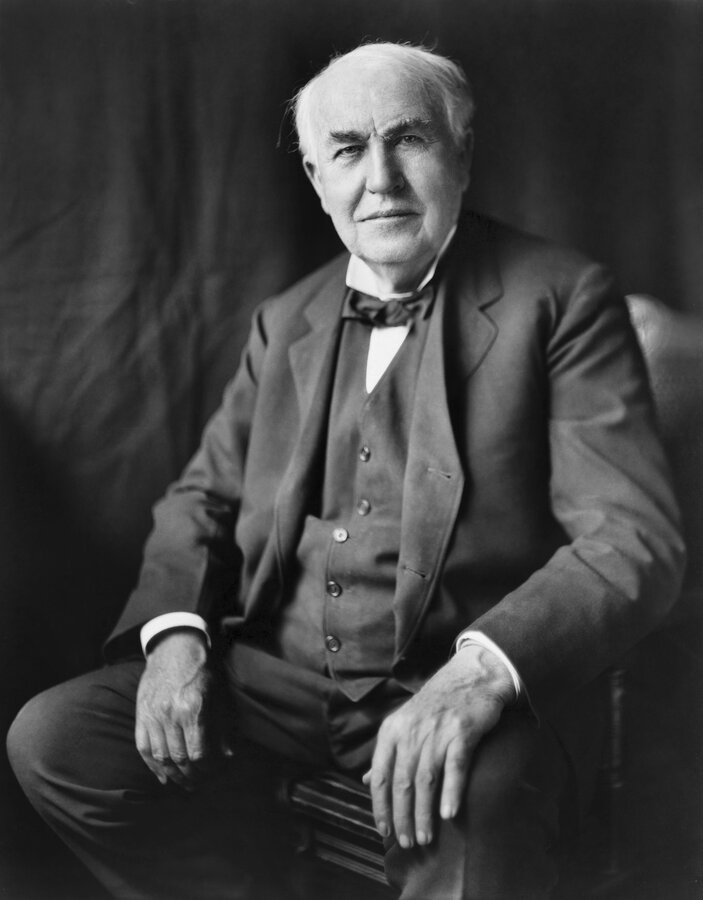
Thomas Edison and the Birth of the Electrical Industry
Thomas Alva Edison (1847-1931) was the American inventor and businessman who played a central role in the development of the electrical industry and the modern research-based industrial corporation. Edison’s most famous inventions, including the phonograph, the incandescent light bulb, and the early motion picture camera, are among the defining technologies of the modern world. His laboratory at Menlo Park in New Jersey, the first industrial research laboratory in the world, established the model of organized industrial research that would be followed by companies like General Electric, Bell Labs, and the German chemical companies. Edison’s career shows how the Second Industrial Revolution pulled laboratory science into the corporation, and how the corporation, in turn, paid for it.
Early Life and First Inventions
Edison was born in Milan, Ohio, in 1847, and grew up in Port Huron, Michigan. He had only a few months of formal schooling, but he was an avid reader and a tireless experimenter, and he acquired most of his education through self-directed study. By the age of twelve, he was working as a newsboy and candy seller on the trains of the Grand Trunk Railway, and he had set up a small laboratory in a baggage car where he conducted chemical experiments.
Edison’s first major invention was an improved stock ticker, developed in 1869, which he sold to the Gold and Stock Telegraph Company for $40,000. The money allowed him to set up a series of small workshops and to devote himself full-time to invention. Over the next decade, he developed a wide range of devices, including an improved version of the telegraph, a mimeograph machine, and the phonograph, the first practical device for recording and reproducing sound, which he patented in 1878.
The phonograph made Edison famous. He was hailed as the “Wizard of Menlo Park,” and he was invited to demonstrate his inventions at the White House and in European capitals. The phonograph also established Edison’s reputation as an inventor who could take a new scientific idea and turn it into a practical device.
The Electric Light
Edison’s most important work, however, was the development of the practical incandescent light bulb and the electrical system to power it. Edison began working on the light bulb in 1878, and he and his team at Menlo Park spent the next two years experimenting with different materials and designs. The challenge was to find a material that would glow brightly when an electric current was passed through it, but that would not burn up quickly.
After thousands of experiments, Edison and his team discovered that a carbon filament, made from carbonized cotton thread, would work. The first practical Edison light bulb was demonstrated in October 1879, and it glowed for more than 13 hours before burning out. Edison and his team continued to improve the design, and by 1880 they had developed a bulb that could last for more than 1,200 hours.
The development of the light bulb was only part of Edison’s project. He also developed the dynamos, the wiring, the switches, the fuses, and the meters needed to distribute electricity to homes and businesses. The result was the Pearl Street Station, the first commercial electric power station, which began operation in New York City in September 1882. The Pearl Street Station initially served about 85 customers and about 400 light bulbs, but it soon expanded, and it became the model for the electric power industry.
Edison General Electric
In 1889, Edison merged his various electrical companies with the Thomson-Houston Electric Company to form the Edison General Electric Company, which was later renamed General Electric. General Electric became one of the largest and most important companies in the world, and it was the foundation of Edison’s fortune.
Edison’s relationship with his company was complicated. He was the most famous inventor in the world, but he was not a particularly good businessman, and he often lost control of the companies that bore his name. The company that eventually became General Electric was actually a combination of Edison’s companies and the rival Thomson-Houston company, and Edison’s role in the merged firm was limited. Despite this, Edison remained a celebrity and a symbol of American invention and entrepreneurship.
The War of the Currents
Edison’s electrical system was based on direct current (DC), which was suitable for short-distance transmission but lost voltage over long wires. The alternative system, based on alternating current (AC), was developed by George Westinghouse and the Serbian-American inventor Nikola Tesla, and it could transmit electricity over much longer distances. The article on Nikola Tesla and the AC system describes this important alternative.
The war of the currents, which played out in the late 1880s and early 1890s, was eventually won by the AC system, largely because of its superior ability to transmit electricity over long distances. Edison fought the AC system fiercely, and he was even involved in the development of the electric chair as a way of demonstrating the supposed dangers of AC. The article on the causes of the Industrial Revolution describes the institutional context of these developments.
Despite losing the war of the currents, Edison remained an important figure in the electrical industry. General Electric, the company that bore his name, became one of the largest electrical equipment manufacturers in the world, and it continued to use Edison’s name as a marketing tool long after he had lost control of the company.
Edison’s Other Inventions
Edison was a prolific inventor throughout his long life. He held more than 1,000 patents, covering a wide range of devices, including the phonograph, the incandescent light bulb, the motion picture camera, the storage battery, the mimeograph, and many others. His later career was less successful than his earlier one, but he continued to work on new inventions until his death in 1931 at the age of 84.
Edison’s later career included the development of the motion picture industry. He and his team developed the kinetoscope, a device for viewing moving pictures, in the early 1890s, and they later developed the first motion picture studio, the Black Maria, in West Orange, New Jersey. The motion picture industry that grew out of these early experiments would become one of the defining industries of the twentieth century.
Menlo Park and the Industrial Research Laboratory
Perhaps Edison’s most important contribution to the modern world was the establishment of the first industrial research laboratory at Menlo Park. Before Menlo Park, invention was largely a solitary activity, carried out by individual inventors working alone or with a few assistants. Edison’s laboratory was different: it was a large, well-equipped facility with a team of scientists, engineers, technicians, and craftspeople working together on multiple projects at the same time.
The Menlo Park model, with its team approach to research and development, its emphasis on practical results, and its focus on commercial applications, became the standard for industrial research. The great industrial research laboratories of the late nineteenth and early twentieth centuries, including the Bell Labs, the General Electric Research Laboratory, the German chemical companies’ labs, and the research labs of firms like DuPont, Standard Oil, and the Edison companies, were all in some sense descendants of Menlo Park.
Edison’s Legacy
Thomas Edison died in 1931, by which time the electrical industry that he had helped to create was one of the largest in the world, and his name had become synonymous with American invention. Edison’s career is a reminder that the Second Industrial Revolution was driven by the work of particular inventors who combined technical knowledge with practical skill and entrepreneurial ambition, alongside abstract scientific discoveries.
Edison’s legacy is complicated. He was not a great scientist, and many of his inventions built on the work of others. He was not a particularly good businessman, and he often lost control of the companies that bore his name. He was also not always right, and his defense of the DC system against the AC system is an example of his occasional inability to recognize the superiority of a competing technology. Despite these limitations, Edison was a central figure in the development of the modern electrical industry, and his career illustrates the combination of technical skill, commercial instinct, and sheer persistence that defined the industrial age.
The Continuing Question
The unresolved question about Edison is how much credit he deserves for the inventions attributed to him. The traditional answer, going back to the 1920s and given its modern form in the schoolbook accounts, is that Edison was the heroic single inventor of the phonograph (1877), the incandescent light bulb (1879), the moving-picture camera (1891), and a long list of other modern technologies. The revisionist answer, developed in Paul Israel’s Edison: A Life of Invention (1998) and given a more pointed form in the recent work of technology historian Matthew Josephson, is closer to a team-and-community story: the phonograph derived from work by French inventor Charles Cros and was a relatively simple device by 1877, the incandescent bulb had working versions from Joseph Swan and others in the 1860s and 1870s, the moving-picture camera was the work of multiple inventors including Wordsworth Donisthorpe and the Lumière brothers, and Menlo Park itself was a 19th-century research-and-development organization whose output was the work of a dozen skilled engineers, not a single inventor. The interesting current question, raised in the work of business historian Thomas Hughes and developed in the recent literature on the “great inventor” myth, is whether Edison’s reputation reflects a 19th-century American self-made-man mythology that was already being constructed in his lifetime, or whether it reflects a real if less monolithic contribution. The honest answer, given the historical evidence, is probably: a little of both. Edison was an unusually effective organizer of research, an unusually effective patent strategist, and an unusually effective publicist for his own work, and the 19th-century American self-made-man mythology is the right way to read the legend, even if it is not the right way to read the inventions.
See also
Selected Sources
- Paul Israel, Edison: A Life of Invention (1998).
- Thomas P. Hughes, Networks of Power: Electrification in Western Society, 1880-1930 (1983).
- Ernest Freeberg, The Age of Edison: Electric Light and the Invention of Modern America (2013).
- Robert H. Wiebe, The Search for Order, 1877-1920 (1967).