
The Bessemer Process: The Invention That Made Cheap Steel Possible
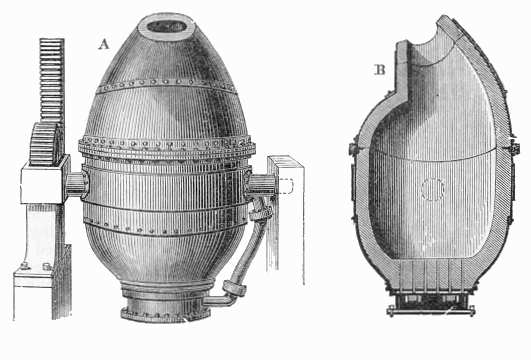
The Bessemer process, developed by Henry Bessemer and patented in 1856, was the first inexpensive industrial method for the mass production of steel from molten pig iron. The process transformed the steel industry, made possible the great expansion of the railway, shipbuilding, and construction industries in the second half of the nineteenth century, and laid the foundation for the Second Industrial Revolution.
The Problem of Cheap Steel
To understand the importance of the Bessemer process, it helps to understand the steel industry of the mid-nineteenth century. Steel, an alloy of iron and carbon that is stronger, harder, and more versatile than either iron or wrought iron, had been known for centuries. But producing steel in large quantities was difficult and expensive. The traditional method, the cementation process, involved heating bars of wrought iron in a sealed furnace with charcoal for several days, and it produced only small quantities of high-quality steel at high cost.
The result was that steel was a relatively scarce and expensive material, used mainly for specialized applications such as cutlery, springs, and tools. The great iron bridges, the iron-framed buildings, the iron ships, and the iron railways of the early nineteenth century had been built with iron rather than steel, because steel was too expensive. The need for a cheaper method of producing steel was clear, and several inventors had tried to develop one.
Bessemer’s Invention
Henry Bessemer was an English inventor and engineer with a wide range of interests, including metallurgy, glass, and sugar refining. He was working on a new type of projectile when he became interested in the problem of producing cheap steel. Through a series of experiments, Bessemer discovered that blowing air through molten pig iron burned off the excess carbon and produced steel rather than wrought iron. The process was rapid, taking only about 20 minutes to convert a charge of molten iron into steel, and it could be carried out in a single vessel, the Bessemer converter.
Bessemer patented the process in 1856, and he announced it at a famous meeting of the British Association for the Advancement of Science. The announcement was met with skepticism by the established metallurgists of the time, but Bessemer pressed on with the development, and within a few years the process was being used in steelworks around the world.
The Initial Difficulties
The early Bessemer converters had a serious problem. The steel they produced was often brittle and unreliable, because the process did not remove the phosphorus that was present in most British iron ores. Phosphorus made the steel brittle, especially at low temperatures, and it limited the usefulness of the Bessemer process for the iron ores of Britain.
The problem was eventually solved by Sidney Gilchrist Thomas and Percy Gilchrist, who in 1878 developed the basic Bessemer process, in which the converter was lined with a basic material (such as dolomite or limestone) rather than an acidic material (such as silica). The basic lining reacted with the phosphorus and removed it from the iron, producing steel that was suitable for a wide range of applications. The basic Bessemer process was particularly important for Britain, which had large deposits of phosphoric iron ores, and it helped to ensure that the British steel industry remained competitive with the steel industries of Germany and the United States.
The Effects of the Bessemer Process
The Bessemer process had several major effects on the steel industry and on the broader economy. It dramatically reduced the cost of producing steel, and it made possible the mass production of steel in quantities that had been unimaginable before. The price of steel fell sharply, from about £40 per ton in the 1850s to about £6 per ton by the 1890s, and steel was gradually substituted for iron in many applications.
The most important of these applications was the railway. The Bessemer process made it possible to produce steel rails in large quantities, and steel rails gradually replaced the older iron rails on the major railway lines. Steel rails were stronger, more durable, and longer-lasting than iron rails, and they were particularly well suited to the heavy traffic of the main lines.
Steel was also used in shipbuilding. The Bessemer process made it possible to build steel-hulled ships in large quantities, and steel-hulled steamships gradually replaced the older iron-hulled ships and wooden ships. Among the earliest vessels often cited as the first all-steel ships are the small French steamer Ma Robert (1858) and, more securely, the British ironclad HMVS Cerberus (1871); by the 1880s steel-hulled ships were the norm.
The construction industry was also transformed by the availability of cheap steel. Steel frames replaced iron frames in large buildings, and steel was used in bridges, viaducts, and other structures. The availability of cheap steel made possible the great engineering works of the late nineteenth and early twentieth centuries, from the Forth Bridge in Scotland to the skyscrapers of Chicago and New York.
The Steel Industry and the Second Industrial Revolution
The Bessemer process was one of the foundations of the Second Industrial Revolution. The cheap steel produced by the process was the material that made possible the great steel industries of the late nineteenth and early twentieth centuries, from the Carnegie Steel Company in the United States to the Krupp steelworks in Germany.
The steel industry was also a major customer of the iron ore and coal industries, since the Bessemer converter required large quantities of both. The growth of the steel industry therefore stimulated the growth of the mining industries, and the demand for iron ore and coal helped to drive the development of new mining regions in places like the Mesabi Range in the United States, the Lorraine region of France, and the Ruhr Valley in Germany.
The steel industry was also closely tied to the development of the modern corporation. The great steel companies of the late nineteenth century, including Carnegie, Krupp, and the various combinations that would eventually form United States Steel, were among the first modern industrial corporations, with their complex structures of ownership, management, and finance.
The Open Hearth Process and the Basic Oxygen Process
The Bessemer process was eventually supplemented, and largely replaced, by two other processes. The open hearth process, developed in the 1860s by Carl Wilhelm Siemens and Émile Martin, used a reverberatory furnace to melt the iron and allowed for greater control over the composition of the steel. The open hearth process could use scrap steel as well as pig iron as a raw material, and it was particularly useful for producing high-quality steel for demanding applications.
The basic oxygen process, developed in the 1950s, used pure oxygen blown through a water-cooled lance to remove the excess carbon and impurities from the pig iron. The basic oxygen process was faster and more efficient than the open hearth process, and it gradually replaced the open hearth process as the dominant steelmaking method in the second half of the twentieth century.
The story of the development of the three major steelmaking processes — the Bessemer, the open hearth, and the basic oxygen — illustrates how industrial innovation tends to be cumulative. Each process was developed to address the limitations of its predecessor, and each contributed to the steady fall in the price of steel and the rise in the volume of production.
The Legacy of the Bessemer Process
The Bessemer process is often cited as one of the most important inventions of the Industrial Revolution, second only to the steam engine in its impact on the modern world. The availability of cheap steel made possible a wide range of technologies, from the railway and the steamship to the skyscraper and the automobile, and it helped to create the material basis of the modern industrial economy.
Before Bessemer, steel was a relatively scarce and expensive material, used mainly for specialized applications. After Bessemer, steel became a mass-produced commodity, available in vast quantities and at low cost. The transformation of steel from a specialty product to a mass-produced material is closely tied to the broader transformation of industry in the late nineteenth century.
The Continuing Question
The unresolved historical question about the Bessemer process is who actually fixed it. The traditional answer, going back to Bessemer’s own Sir Henry Bessemer, F.R.S.: An Autobiography (1905) and given its modern form in the standard schoolbook accounts, credits the work of the English metallurgist Robert Mushet, who in 1856-1858 patented the addition of spiegeleisen (a manganese-iron alloy) to the converter. The revisionist answer, developed in Thomas Misa’s A Nation of Steel (1995) and given a more pointed form in the work of the iron-and-steel historian Peter Temin, is that Mushet’s patent was narrow and probably not enforceable, and that the practical Bessemer process was the work of the Swedish engineer Göran Fredrik Göransson, who in 1858 built a working converter at Högbo Bruk that handled the high-phosphorus ores that the English plant could not. The answer matters because the Swedish Bessemer process was the basis of the Belgian, German, and American industries, and the English patent pool lost control of the technology in the 1860s. The interesting current question, raised in the work of economic historian Robert Allen and developed in the recent literature on the global diffusion of British inventions, is whether the standard British-history picture (the Bessemer converter was a British invention, and the world eventually adopted it) is the right way to read the late-19th-century steel industry, or whether the picture should be inverted (the British invention did not work, the Swedish and German engineers fixed it, and the world adopted their version). The honest answer, given the historical evidence, is probably closer to the second.
Selected Sources
- Bessemer, Henry. Sir Henry Bessemer, F.R.S.: An Autobiography. London: Offices of “Engineering,” 1905.
- Allen, Robert C. The British Industrial Revolution in Global Perspective. Cambridge: Cambridge University Press, 2009.
- Landes, David S. The Unbound Prometheus: Technological Change and Industrial Development in Western Europe from 1750 to the Present. Cambridge: Cambridge University Press, 1969.
- Misa, Thomas J. A Nation of Steel: The Making of Modern America, 1865–1925. Baltimore: Johns Hopkins University Press, 1995.