
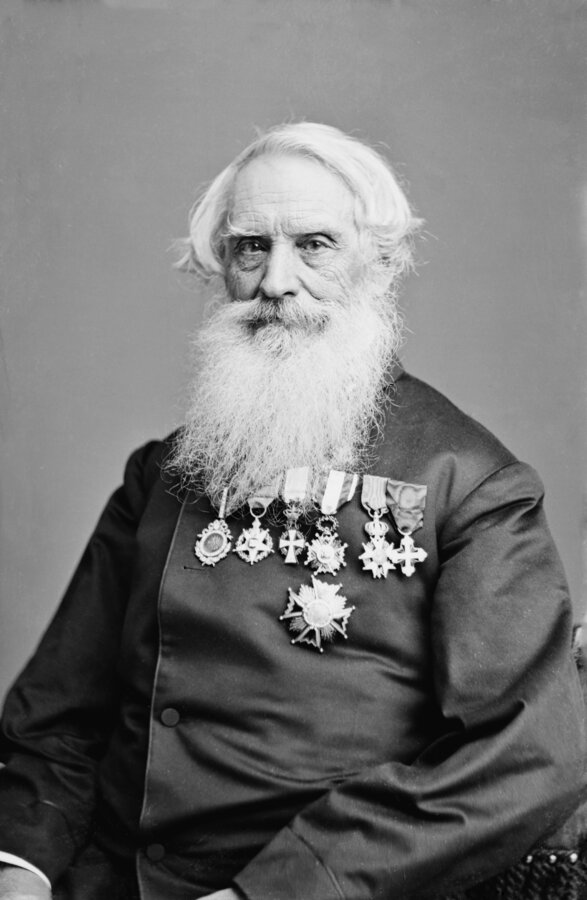
Samuel Morse and the Telegraph
Samuel F. B. Morse (1791–1872) was an American painter turned inventor whose single-wire telegraph, patented in 1840, became the first commercial electrical communication system in the United States. His partnership with Alfred Vail and Leonard Gale produced the working instrument that carried the famous 1844 message “What hath God wrought” between Washington and Baltimore.
Early Life and Career as an Artist
Morse was born on 27 April 1791 in Charlestown, Massachusetts, the son of Jedidiah Morse, a prominent geographer and Calvinist minister. He graduated from Yale College in 1810, then spent four years in London studying painting under Washington Allston and Benjamin West. Returning to the United States in 1815, he established himself as one of the leading American portraitists of his generation, founding the National Academy of Design in 1826 and serving as its first president.
Morse’s career as a painter is often summarised by a single monumental work: Gallery of the Louvre (1831–33), a large canvas depicting more than thirty masterpieces in the Salon Carré, painted in America from memory and sketches. The painting was a critical and commercial disappointment, and Morse increasingly had to support himself by teaching and writing about art. He never abandoned painting, but the financial insecurity of the profession helped push him toward invention.
The Idea for the Telegraph
The story of the telegraph’s origin is one of the most repeated in American technological history. In October 1832, aboard the packet Sully on the return voyage from a European trip, a fellow passenger — Dr. Charles T. Jackson, a Portland, Maine physician with interests in electro-magnetism — described recent experiments with the electromagnet. Morse later wrote that in that conversation he first conceived of “an Electric Telegraph” using a single circuit and an electromagnet to mark signals on a moving strip of paper.
The story is plausible but not uncontested. Historians including Kenneth Silverman (Lightning Man, 2003) and Paul J. Staiti (Samuel F. B. Morse, 1989) note that Morse was already familiar with the work of Joseph Henry and had considered electrical signaling before the voyage. The conventional date of 1832 is therefore a useful marker, not a clean starting point.
The Development of the Telegraph
Morse did not begin serious work on the telegraph until 1835, and then largely in private. He taught at the University of the City of New York (now NYU) and worked on a prototype in his rooms at the university and at his brother’s country house on Staten Island. By 1835–36 he had a working but unreliable instrument.
In late 1837 he secured two important collaborators. Alfred Vail (1807–1859), a skilled mechanic from a New Jersey ironworking family, contributed the key mechanical redesigns of the transmitter and receiver. Leonard Gale, a chemistry professor at NYU, corrected errors in Morse’s understanding of circuit resistance and battery sizing that had been ruining the prototypes. The Morse–Vail–Gale team demonstrated their improved instrument to a small audience at the university in January 1838.
The 1843 Congressional appropriation of $30,000 — championed by Representative F. O. J. Smith of Maine, who became a partner in the patent — funded an experimental line between Washington and Baltimore. Annie Ellsworth, daughter of the U.S. Patent Commissioner Henry Leavitt Ellsworth, chose the now-famous inaugural message from Numbers 23:23: “What hath God wrought.” On 24 May 1844 it was sent the forty miles from the Capitol to the Mount Clare Station in Baltimore.
The Patent Disputes
Morse received U.S. patent 1,647 on 20 June 1840 for “Improvement in the Mode of Communicating Information by Signals by the Application of Electro-Magnetism.” He spent the rest of his life defending it. The disputes fell into three groups:
-
Priority disputes with European inventors — Cooke and Wheatstone (England, 1837), Carl Friedrich Gauss and Wilhelm Weber (Göttingen, 1833), Pavel Schilling (Russia, 1832). The transatlantic debate over who first built a working telegraph is unresolved and probably unresolvable; all of the candidates above built working models before Morse.
-
The 1846 Patent Office reissue. The U.S. Patent Office reissued Morse’s patent in 1846 under Commissioner Edmund Burke, broadening the claims. The reissue was contested by several rivals and, in O’Reilly v. Morse (1854), the U.S. Supreme Court upheld the reissue but ruled that the eighth claim of the patent — which would have covered “the use of the motive power of the electric or galvanic current … however developed, for making or printing intelligible characters, letters, or signs, at any distances” — was too broad and invalid. The ruling is still studied in U.S. patent law as a foundational case on the limits of software-type claims.
-
The Smith controversy. F. O. J. Smith, who had done the crucial Congressional lobbying for the 1843 appropriation, claimed an eighth share of the patent royalties under an 1848 agreement. A 1857 settlement split the proceeds eight ways; the dispute dragged through the courts for two decades.
The Spread of the Telegraph
The telegraph spread with remarkable speed. By 1850 there were roughly 12,000 miles of line in the United States; by 1860, more than 50,000 miles. The 1866 successful Atlantic cable (the 1858 cable had failed after a few weeks) made the global telegraph network practical. By 1900 nearly every significant point on the globe was within hours of electrical communication, and time zones themselves — adopted at the 1883 U.S. and 1884 International Meridian conferences — were a direct response to the speed of the telegraph.
The Legacy of Morse
Morse spent his later years in litigation and philanthropy. He gave generously to Protestant missionary and temperance causes and supported the nativist movement, including the founding of the New York Journal of Commerce. He died in New York on 2 April 1872, age 80, three years after the death of Vail, whose mechanical and financial contributions the legal record systematically underplays.
The single-wire Morse telegraph was the founding technology of the modern telecommunications industry, but its invention was collaborative. To remember it as the work of one man is, as Kenneth Silverman argues, a tribute to one of the most effective pieces of personal branding in 19th-century America — and a distortion of the history.
The Continuing Question
The unresolved historical question about the telegraph is whether it was a natural monopoly, and what the answer implies for 21st-century network industries. The traditional answer, going back to the 1866 Atlantic Cable and given its modern form in the work of Alfred Chandler and the New Institutional Economics, is that the telegraph was a textbook natural monopoly: the cost of duplicating the right-of-way was prohibitive, the value of a single integrated network grew with the number of subscribers (Metcalfe’s Law before Metcalfe), and the result was an industry that had to be either regulated or consolidated. The U.S. response was Western Union’s near-monopoly by 1866 and the 1910 Kingsbury Commitment; the British response was the nationalization of the inland telegraph network as part of the General Post Office in 1870. The interesting current question, raised in the post-1984 breakup of AT&T and in the recent literature on the layered internet (the “end-to-end” architecture that the FCC’s 2005 Internet Policy Statement tried to formalize), is whether the natural-monopoly argument was ever right. The empirical evidence from the 1990s-2010s — multiple fibre-optic networks in the same urban corridor, mobile networks competing in the same spectrum bands, the success of dark fibre and cable-modem competition — suggests that natural monopoly in networks is a contingent claim, not a structural one, and that what looked like natural monopoly in 1870 was actually the result of a particular regulatory and capital-market regime. The question is now being argued in the context of the 5G rollout, the Starlink low-orbit constellation, and the AI compute-network buildout, where the same Metcalfe’s-Law logic is being deployed. The history of the telegraph, in other words, is more relevant to the present than its age would suggest.
Selected Sources
- Kenneth Silverman, Lightning Man: The Accursed Life of Samuel F. B. Morse (Knopf, 2003)
- Paul J. Staiti, Samuel F. B. Morse (Cambridge University Press, 1989)
- O’Reilly v. Morse, 56 U.S. (15 How.) 62 (1854)
- Tom Standage, The Victorian Internet (Walker, 1998)
For more on the spread of the technology, see the telegraph and Morse code.