
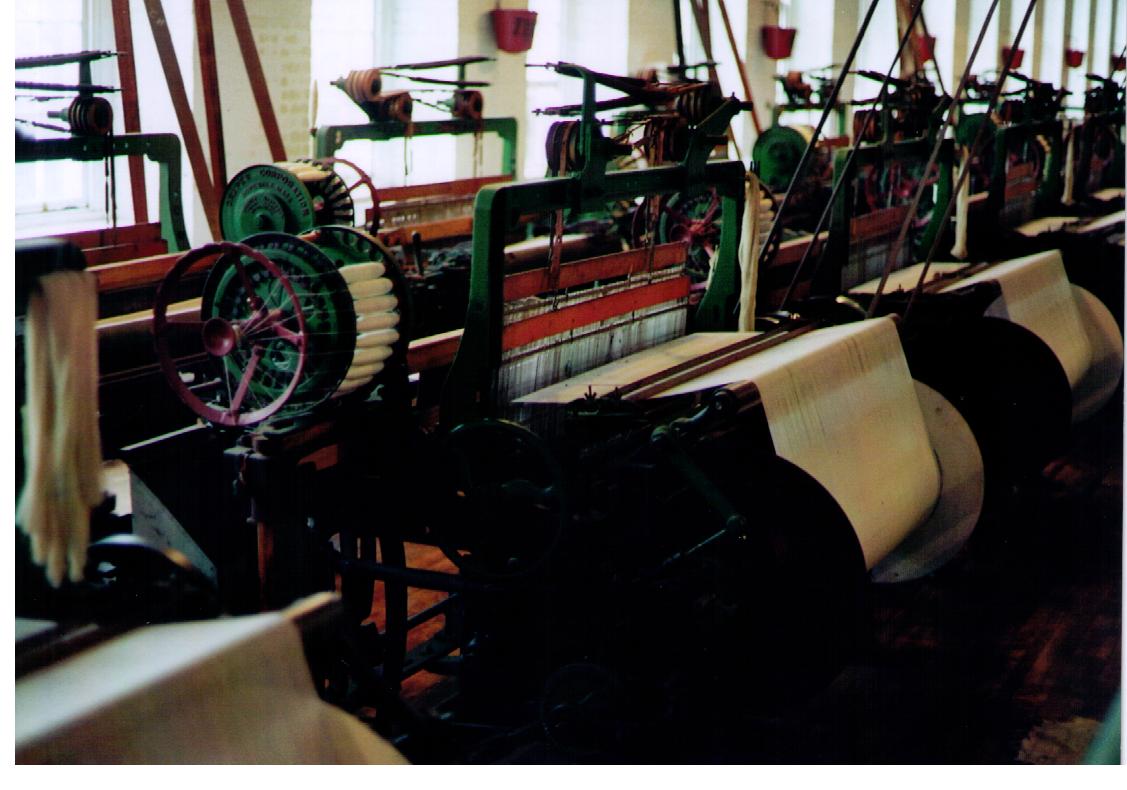
Edmund Cartwright: The Inventor of the Power Loom
Edmund Cartwright (1743-1823) was the English clergyman and inventor who developed the power loom, the machine that completed the mechanization of the British textile industry. Cartwright had no prior experience with weaving or manufacturing, but his invention of the power loom, patented in 1785, helped to transform the textile industry and laid the foundation for the modern factory.
Early Life and Career
Cartwright was born in 1743 in Marnham, Nottinghamshire, the son of a merchant. He was educated at Oxford and entered the Church of England, serving as rector of a parish in Kent. Cartwright was also a poet of some distinction, and he published a number of poems and translations during his lifetime.
Cartwright was not trained as an engineer or a manufacturer, and he had no experience with the textile industry. His interest in the power loom was sparked by a visit to a cotton mill in 1784, where he saw the spinning machines developed by Richard Arkwright and was struck by the inefficiency of the weaving process. According to his own account, he became convinced that weaving could be mechanized in the same way that spinning had been.
The Invention of the Power Loom
Cartwright began to work on a power loom in 1784, and within a year he had produced a working model. He applied for a patent in 1785, and the patent was granted. Cartwright’s first loom was a relatively simple device that used a single large wheel to drive a number of shuttles, each carrying a weft thread, across the loom. The loom was heavy, inefficient, and prone to break threads, and the cloth it produced was of poor quality.
Cartwright was not a skilled mechanic, and he relied on the help of a local blacksmith and other craftsmen to build and refine his designs. Over the next few years, he developed several improved versions of the loom, and he worked to persuade other inventors and manufacturers to adopt the technology.
The article on the power loom development describes the broader context of the development of the power loom.
The Doncaster Mill
In 1787, Cartwright opened a weaving mill in Doncaster equipped with several of his power looms. The mill was destroyed by fire, possibly arson, in the same year. Cartwright rebuilt, but the mill was never profitable, and by 1793 he had been forced to give up the project. The experience of the Doncaster mill was a setback for Cartwright, but it also provided valuable practical experience that helped to inform the development of the power loom by other inventors.
The story of the Doncaster mill illustrates the difficulties of commercializing a new technology. Cartwright was an inventor, not a businessman, and he lacked the skills and the resources needed to make a success of his invention. The development of the power loom was eventually taken up by other engineers, including William Radcliffe and Thomas Johnson, who built on Cartwright’s original ideas to produce the reliable and efficient power loom that became the standard of the industry.
The Parliamentary Reward
In 1809, Edmund Cartwright petitioned Parliament for a reward in recognition of his contribution to the textile industry. Parliament voted him a grant of £10,000, a substantial sum at the time, in recognition of the value of his invention. The grant did not make Cartwright a rich man, but it did provide some financial recognition for the work he had done.
The Parliamentary grant was an important precedent. It was the first time that the British government had recognized the contribution of an individual inventor to the industrial development of the country, and it established the principle that the state had a role to play in supporting technological innovation.
The Later Career of Cartwright
Cartwright continued to invent and to take an interest in mechanical matters for the rest of his life. He worked on designs for a wool-carding machine and on a fire engine, and he remained active in the scientific and engineering circles of the time. He died in 1823, by which time the power loom had become the standard method of weaving in the British cotton industry.
Cartwright’s later career illustrates the often difficult position of the inventor in the Industrial Revolution. Despite the importance of his invention, Cartwright did not make a fortune from it, and he relied on the Parliamentary grant to support himself in his later years. The contrast with James Watt, who in partnership with Matthew Boulton made a fortune from the steam engine, is striking. Watt succeeded where Cartwright failed because Watt had a better understanding of how to protect and commercialize his inventions, and because his invention was more complex and harder to copy.
The Legacy of Cartwright
Despite the limited personal reward that Cartwright received, his invention had a profound effect on the British textile industry and on the broader Industrial Revolution. The power loom was one of the key inventions of the Industrial Revolution, and it helped to complete the transformation of the textile industry from a rural handicraft into a mechanized factory production.
The power loom also illustrates the way in which the new industrial technology was developed and refined over time. Cartwright’s original design was crude and impractical, but it pointed the way to a new kind of weaving machine, and a series of subsequent inventors built on his work to produce the reliable and efficient power loom that became the standard of the industry.
Cartwright’s career illustrates how the Industrial Revolution rewarded both invention and persistence, and his legacy continues to shape the modern world.
The Continuing Question
The unresolved question about Cartwright is whether the 1809 Parliamentary grant of £10,000 was a sound precedent or a mistake. The traditional view, going back to the Hammonds’ The Skilled Labourer (1919) and given its modern form in Christine MacLeod’s Heroes of Invention (2007), is that the grant was justified: Cartwright’s 1785 patent had been the public record of a real invention, and his Doncaster mill had provided the practical lessons that other engineers built on. The revisionist view, developed in Joel Mokyr’s The Lever of Riches (1990) and in the work of economic historian Robert Allen, is that the grant was a windfall paid to the wrong person: the working power loom of 1810-1820 was substantially the work of William Radcliffe, Thomas Johnson, and Richard Roberts, and the Cartwright patent was a barrier to improvement that Parliament ought to have invalidated rather than rewarded. The interesting current question, raised in the work of patent historians and in the recent comparative history of industrial policy, is whether the Parliamentary grant system was a useful form of state support for invention, or whether it was a kind of crony capitalism that gave a £10,000 reward to an inventor whose patent had produced 25 years of slow improvement while denying any recognition to the anonymous Radcliffes and Robertses who did most of the actual engineering. The same question — should the patent holder or the practical improver be rewarded? — recurs in the 1852 reform of the British patent system and in the modern debates over software patents and AI-generated inventions.
See also
- power loom development
- power loom mechanics
- overview of the textile industry
- overview of the Industrial Revolution
Selected Sources
- D.S.L. Cardwell, The Steam Engine: A Scientific Anthology (1971).
- Malcolm Dick, Edmund Cartwright and the Invention of the Power Loom (1990).
- A.E. Musson, Science, Technology and Economic Growth in the Eighteenth Century (1972).
- T.S. Ashton, The Industrial Revolution (1760–1830) (1948).