
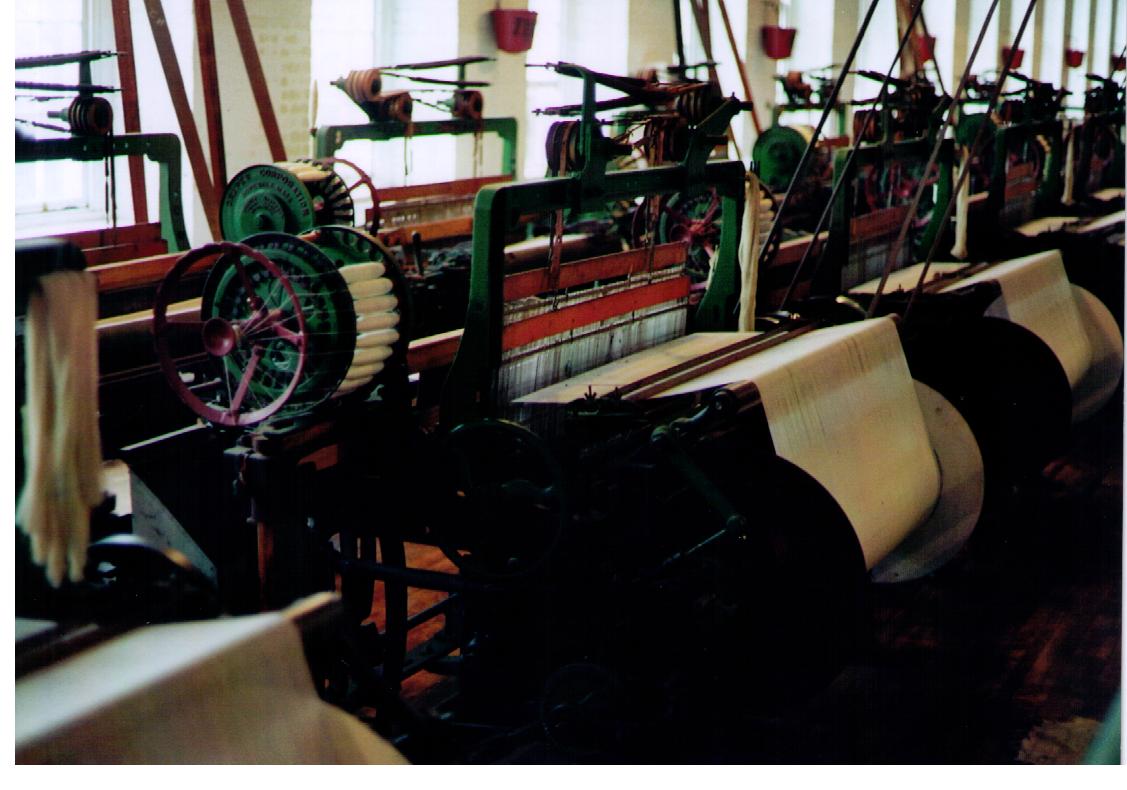
The Power Loom: How Weaving Became Mechanized
The power loom was one of the key inventions of the Industrial Revolution. Invented by Edmund Cartwright in 1785, the power loom mechanized the weaving of cloth and, together with the earlier inventions in spinning, completed the transformation of the textile industry from a rural handicraft into a mechanized factory production. The power loom, and the controversy that surrounded its introduction, illustrates both the power of the new industrial technology and the social tensions that it produced.
Why Weaving Needed Mechanization
By the 1770s, the spinning of yarn had already been partly mechanized by the spinning jenny, the water frame, and the spinning mule. These inventions had dramatically increased the output of yarn, and by the early 1780s the bottleneck in textile production had shifted from spinning to weaving. Weavers could not keep up with the supply of yarn, and cloth was becoming relatively expensive.
The traditional handloom weaver worked at home, using a wooden loom operated by hand and foot. A skilled weaver could produce perhaps a yard or two of plain cloth in a day. With the supply of cheap yarn rising rapidly, the demand for faster weaving grew, and several inventors began to experiment with mechanized looms.
Edmund Cartwright and the First Power Looms
Edmund Cartwright, a clergyman and poet from Kent who had no prior experience with weaving, visited a cotton mill in 1784 and was struck by the inefficiency of the weaving process. According to his own account, he became convinced that weaving could be mechanized in the same way that spinning had been, and within a year he had built a rough but working power loom.
Cartwright’s first loom, patented in 1785, was driven by a single large wheel and could weave a wide piece of cloth. The loom was far from perfect. It broke threads frequently, and the cloth it produced was of poor quality. Cartwright himself was not a skilled mechanic, and he relied on the help of a local blacksmith and other craftsmen to refine his design.
In 1787, Cartwright opened a weaving mill in Doncaster equipped with several of his power looms. The mill was destroyed by fire, possibly arson, in the same year. Cartwright rebuilt, but he was a poor businessman and his mills never made a profit. By 1793, he had been forced to give up the project.
Adoption of the Power Loom
Cartwright’s invention was gradually improved over the following decades by other inventors, including William Radcliffe, Thomas Johnson, and Richard Horrocks. By the 1820s, the power loom had become reliable and productive enough to displace the handloom weaver in most branches of the industry. There were approximately 14,000 power looms in Britain by 1820, rising to around 100,000 by 1835.
The power loom was first widely adopted in the cotton industry, where it was most efficient. Its adoption in the woolen industry was slower, in part because the woolen weavers had powerful guilds and traditions of skilled handwork, and in part because woolen yarns were more difficult to weave by machine. The linen industry was mechanized only in the early nineteenth century, and the silk industry not until later.
The demand for cheap cloth drove the improvements to the loom, and the falling cost of yarn from the new spinning machines made it profitable to invest in weaving technology.
The Effects of the Power Loom
The power loom had several major effects on the textile industry and on society as a whole.
First, it greatly increased the productivity of weaving. A single power loom, operated by a worker whose only job was to keep the machine running and fix broken threads, could produce as much cloth as several handloom weavers. The price of woven cloth fell sharply, and the consumption of cotton cloth in Britain rose dramatically. By the 1830s, cotton had become the most important material in British clothing, and British cotton goods were being exported around the world.
Second, the power loom completed the transformation of the textile industry. With spinning and weaving both mechanized, the entire process of cloth production could be concentrated in a single factory, where a single source of power, first water and then steam, drove all the machines. The result was the classic image of the industrial factory: a large building full of machines, with hundreds of workers performing specialized tasks.
Third, the power loom had a profound effect on the handloom weavers. Weavers who had once earned a good living in their own homes were gradually driven out of work by the cheaper and faster power looms. By the 1840s, handloom weaving had become one of the most poorly paid occupations in Britain, and many weavers had drifted into the new factories or into the ranks of the urban poor. The distress of the handloom weavers became a symbol, in the 1830s and 1840s, of the human cost of the Industrial Revolution.
Finally, the controversy over the power loom, and the attempts of weavers to resist it, foreshadowed the broader political reactions to industrialization. The destruction of machines by Luddites in the 1810s, the petitions to Parliament for protection, and the spread of radical political movements among displaced artisans were all responses to the new industrial technology.
The Legacy of the Power Loom
The power loom continued to be improved throughout the nineteenth century, with the introduction of the Northrop loom in the 1890s being one of the most important later developments. The Northrop loom, with its automatic weft replenishment, dramatically reduced the amount of labor required to operate a loom, and it became the standard loom of the twentieth century.
The power loom’s principles also influenced the development of other types of machines. The use of cams, gears, and synchronized motion to automate a complex process became a model for many other industries, and the textile industry’s experience with mechanization was studied by engineers and entrepreneurs in other fields.
In a broader sense, the power loom represents the completion of a key stage of the Industrial Revolution. The combination of the spinning jenny, the water frame, the spinning mule, the power loom, and the steam engine had, by the 1830s, transformed the production of cloth from a slow handicraft into a fast factory process. The lessons of the textile industry would be applied in other sectors over the following decades, with similarly profound effects.
What It Teaches Us
The unresolved question about the power loom is the same one raised in the cotton-gin and spinning-jenny articles: how to credit a community of practical engineers for a technology whose public patent history credits a single named inventor. The 19th-century answer, going back to George Condy’s 1796 biography of Edmund Cartwright and given its modern form in the 1865 Lives of Boulton and Watt by Samuel Smiles, is the heroic-individual story. The modern answer, developed in Maxine Berg’s The Machinery Question (1980) and in Christine MacLeod’s Heroes of Invention (2007), is closer to the community story: the working power loom of 1810-1820 was substantially the work of William Radcliffe, Thomas Johnson, and Richard Roberts, and Cartwright’s 1785 patent is best read as the public record of an idea that was already in the air, not as the invention itself. The interesting current question, raised in Joel Mokyr’s A Culture of Growth (2016) and in the modern literature on cumulative technology, is whether the heroic-individual story was a 19th-century invention, useful for school readers and patent lawyers, that is no longer the right way to read 19th-century industrial Britain. The Cartwright case, like the Hargreaves and Newcomen cases, suggests that the answer is: no, the community story is the more honest one.
Selected Sources
- Mitchell, B. R. British Historical Statistics. Cambridge: Cambridge University Press, 1988.
- Allen, Robert C. The British Industrial Revolution in Global Perspective. Cambridge: Cambridge University Press, 2009.
- Landes, David S. The Unbound Prometheus: Technological Change and Industrial Development in Western Europe from 1750 to the Present. Cambridge: Cambridge University Press, 1969.
- Humphries, Jane. Childhood and Child Labour in Industrial England: Diversity and Agency, 1750–1914. Cambridge: Cambridge University Press, 2010.