
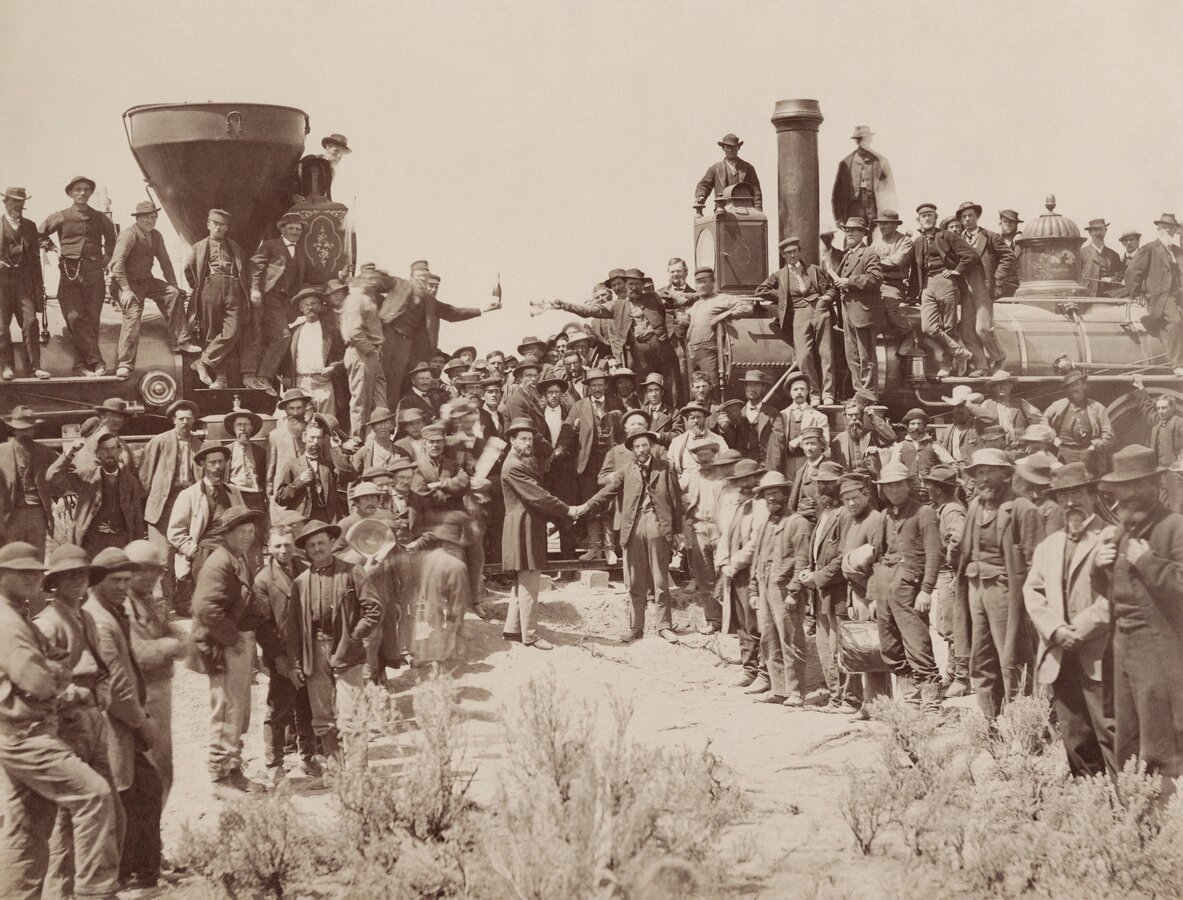
The Transcontinental Railroad: Connecting the Coasts of the United States
The first transcontinental railroad, completed on May 10, 1869, was one of the great engineering achievements of the nineteenth century. The railroad, which connected Omaha, Nebraska, with Sacramento, California, was built by the Union Pacific Railroad working westward and the Central Pacific Railroad working eastward, and it transformed the United States by tying the East and West coasts together and creating a national market for goods.
The Idea of a Transcontinental Railroad
The idea of a railroad that would connect the East and West coasts of the United States had been discussed for decades before the Civil War. The first serious proposal was made in the 1830s, and the idea was supported by various business and political leaders, including the merchant Asa Whitney, who lobbied Congress for federal support for a transcontinental railroad.
The project was opposed by several groups, including Southern politicians, who feared that a northern route would strengthen the Union and weaken the slave-holding South. The South preferred a southern route, which would have run through the slave-holding territories, but this was not feasible because of the difficult terrain of the southern Rockies. The political deadlock prevented any action on a transcontinental railroad until the Civil War.
The Pacific Railway Acts
The Civil War changed the political calculus. With the South out of the Union, the Northern and Western politicians who supported a transcontinental railroad were able to push the project through Congress. The Pacific Railway Act of 1862 authorized the construction of a railroad from Omaha, Nebraska, to Sacramento, California, and it provided land grants and loans for the project. The Pacific Railway Act of 1864 increased the land grants and the loans, and it gave the two railroad companies more flexibility in their operations.
The two companies chosen to build the railroad were the Union Pacific Railroad, which would build westward from Omaha, and the Central Pacific Railroad, which would build eastward from Sacramento. The Union Pacific was led by Thomas C. Durant and later Grenville Dodge, while the Central Pacific was led by the “Big Four” of Leland Stanford, Collis Potter Huntington, Mark Hopkins, and Charles Crocker.
The Construction of the Railroad
The construction of the transcontinental railroad was a major engineering feat. The Union Pacific built across the Great Plains, which was relatively easy terrain, but it had to deal with hostile Native American tribes, who saw the railroad as a threat to their way of life. The Central Pacific had to deal with the far more challenging terrain of the Sierra Nevada, which required the construction of numerous tunnels, bridges, and trestles.
The Central Pacific’s workforce was largely Chinese, with thousands of Chinese workers recruited from the Chinese communities in California and from China itself. The Chinese workers were skilled, hardworking, and willing to work for low wages, but they faced widespread discrimination and dangerous working conditions. Many Chinese workers died in accidents, landslides, and explosions during the construction of the railroad.
The Union Pacific’s workforce was a more diverse mix, including Irish immigrants, Civil War veterans, and African Americans. The conditions of work were also dangerous, with many workers killed in accidents and many more suffering from disease, exposure, and malnutrition. The article on the causes of the Industrial Revolution describes the broader institutional context of these developments.
The construction of the railroad was also a major financial enterprise. The two companies received massive land grants from the federal government, alternating sections of land in a checkerboard pattern for 20 miles on each side of the route, and they used the land as collateral for loans and as a source of additional revenue. The land grants and the loans were the subject of widespread corruption, with the railroad companies and their allies in Congress often profiting at the expense of the public.
The Golden Spike
The two railroads met at Promontory Summit, Utah, on May 10, 1869. The ceremony was attended by a small crowd of railroad officials, workers, and journalists, and it was broadcast by telegraph to audiences across the country. The last spike, a gold spike, was driven by Leland Stanford, the governor of California and a leader of the Central Pacific, into a polished laurel wood tie.
The completion of the transcontinental railroad was celebrated across the country. The journey from New York to San Francisco, which had previously taken months by stagecoach or by ship around Cape Horn, could now be made in a week. The railroad was hailed as a triumph of American engineering and a symbol of American progress.
The Effects of the Transcontinental Railroad
The transcontinental railroad had a transformative effect on the United States. The railroad made possible the rapid movement of people and goods across the continent, and it helped to create a national market for goods. The railroad also opened up the American West to settlement, and it helped to establish the Western states as major economic regions.
The transcontinental railroad was also important for the development of American industry. The railroad was one of the largest customers of the American iron and steel industry, and it helped to create the market for the great steel mills of Pittsburgh. The railroad was also important for the development of the American coal industry, since the locomotives required large quantities of coal, and the coal-producing regions of the Appalachians were closely tied to the railroad network. The article on steel and mass production describes this connection in more detail.
The transcontinental railroad also had important social effects. The railroad made possible the rapid movement of people from one part of the country to another, and it contributed to the great waves of migration that transformed the American population in the nineteenth century. The railroad also had a devastating effect on the Native American tribes of the Great Plains, who were forced off their lands to make way for the railroad and the settlers it brought.
The Legacy of the Transcontinental Railroad
The transcontinental railroad was one of the defining achievements of the nineteenth century. The railroad, with its tracks stretching from the Atlantic to the Pacific, was a powerful symbol of American unity and progress, and it helped to establish the United States as a continental power. The railroad also helped to make the American West an integral part of the American economy, with cities like San Francisco, Denver, and Salt Lake City becoming major centers of trade and industry.
The transcontinental railroad also established a model of government-business cooperation that would be imitated in many other areas of American life. The federal government provided the land grants and the loans, the railroad companies provided the capital and the management, and the resulting partnerships helped to develop the American economy. The model was not without its abuses, as the Credit Mobilier scandal of 1872 demonstrated, but it helped to establish the United States as a major industrial power.
The transcontinental railroad belongs in the same company as the Erie Canal and the Interstate Highway System: a public investment that made possible the integration of a continental economy.
The Continuing Question
The unresolved question about the transcontinental railroad is whether the federal land grants and loans were a good investment. The traditional answer, going back to the 1870s’ “American System” rhetoric and given its modern form in the work of economic historian Carter Goodrich, is that they were: the railroad opened up the West, integrated the national market, and produced a return to the federal government in increased tax revenue, lower transport costs, and higher land values. The revisionist answer, given its most influential modern form in Robert Fogel’s Railroads and American Economic Growth (1964), is more cautious: Fogel’s “social savings” estimate for the U.S. railroad system in 1890 was only about 4.7 percent of national income, far below the figure implied by mid-Victorian railroad boosters, and the marginal contribution of the transcontinental line specifically was much smaller still. The interesting current question, raised in the work of economic historian Mark H. Rose and developed in the recent literature on the comparative history of federal infrastructure, is whether the transcontinental land grants were a sound precedent for the 20th-century federal role in infrastructure (the Interstate Highway System, the air-traffic-control system, the broadband buildout), or whether the railroad land grants were a one-off that depended on the unique conditions of the 1860s (the absence of a developed private capital market, the genuine uncertainty about whether the railroad would ever pay). The honest answer, given the historical evidence, is probably: both, and the comparative international data (the Canadian Pacific, the Trans-Siberian, the Australian transcontinental) suggest that the land-grant model worked best when the railroad was being built through a territory with no prior development, and worst when it was being built through already-developed private land.
See also
- railroad barons
- railroads in America
- overview of the American Industrial Revolution
- overview of the Industrial Revolution
Selected Sources
- John F. Stover, The Routledge Historical Atlas of the American Railroads (1999).
- Robert W. Fogel, Railroads and American Economic Growth (1964).
- Alfred D. Chandler Jr., The Visible Hand (1977).
- Maury Klein, Union Pacific: The Birth of a Railroad 1862–1893 (1987).