
Railroads in America: The Industry That Tied the Nation Together
The American railroad was one of the defining institutions of the nineteenth century. The development of the American railroad transformed the country, tied the East and West coasts together, created a national market, and helped to make the United States the world’s largest industrial economy. The article on railroads in America describes this important development in more detail.
The First American Railroads
The first American railroads were short, local lines designed to carry coal or other bulky materials. The Granite Railway of Quincy, Massachusetts (chartered 1826) is generally considered the first chartered commercial railroad in the United States, although it was built primarily to transport granite from Quincy quarries to a dock on the Neponset River. The Delaware and Hudson Canal Company built the first American steam locomotive to run on rails in 1828, and the Tom Thumb of the Baltimore and Ohio Railroad (1829) — designed by Peter Cooper — was the first American-built steam locomotive to operate on a common-carrier railroad. The first section of the Baltimore and Ohio Railroad, the first common-carrier railroad in the United States, opened on 22 May 1830, the same year as the Liverpool and Manchester Railway in Britain (15 September 1830).
The Growth of the American Railroad Network
The American railroad network grew rapidly in the middle decades of the nineteenth century, from a few hundred miles in 1830 to more than 30,000 miles by 1860. The growth was driven by several factors, including the demand for transport from the growing industrial economy, the availability of capital from American and European investors, and the support of state and federal governments.
The Civil War and the American Railroad
The American Civil War had a major impact on the American railroad. The war disrupted the railroad network, particularly in the South, where many railroads were destroyed or damaged. The war also demonstrated the strategic importance of the railroad, and the Union victory in the war was in part a result of the Union’s superior railroad system.
The Transcontinental Railroad
The transcontinental railroad was one of the great engineering achievements of the nineteenth century. The article on the transcontinental railroad describes this important development in more detail.
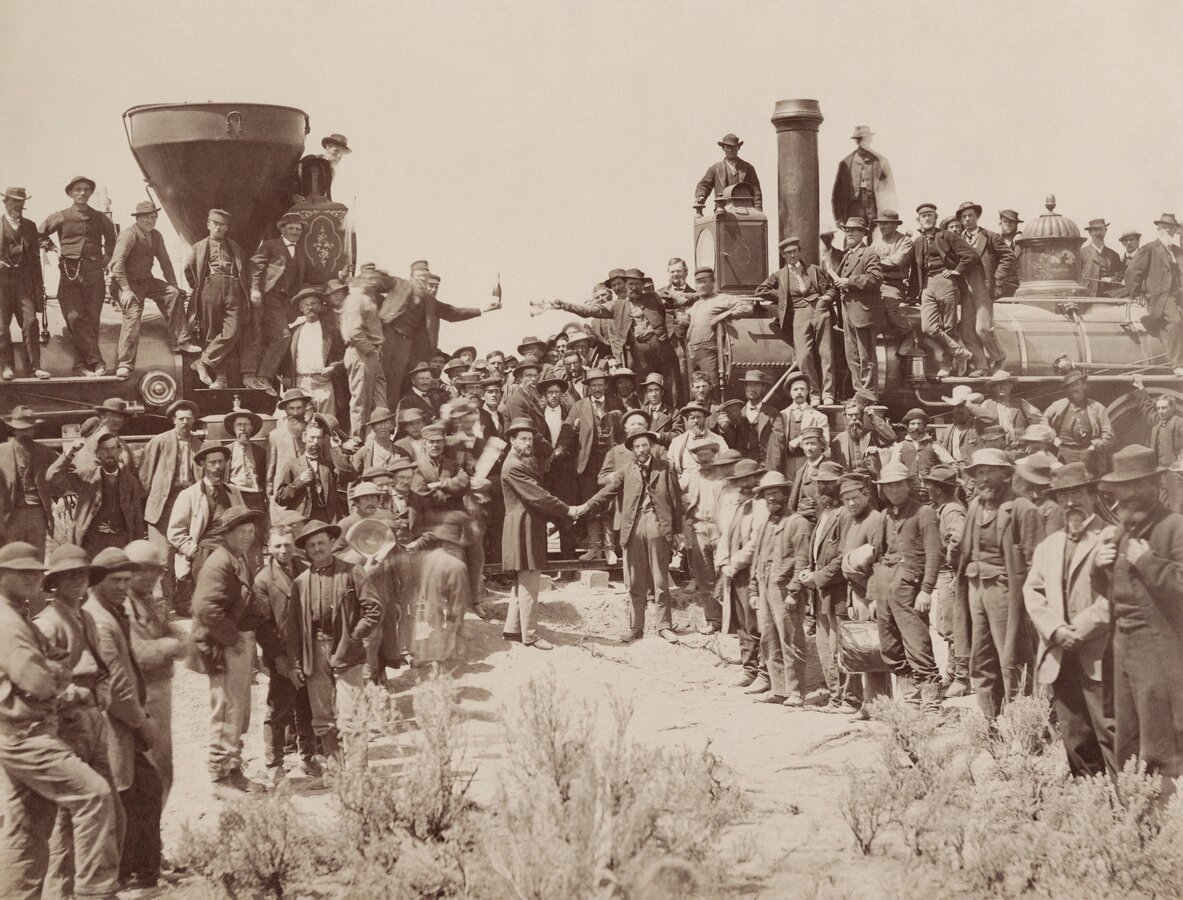
The construction of the transcontinental railroad was a major engineering feat, with the Central Pacific and the Union Pacific building across the Great Plains, the Rocky Mountains, and the Sierra Nevada. The two railroads met at Promontory Summit, Utah, on May 10, 1869, when the famous “golden spike” was driven. The completion of the transcontinental railroad transformed the United States, making possible the rapid movement of people and goods across the continent.
The Railroad Barons
The American railroad was built and operated by a generation of great entrepreneurs known as the railroad barons. The most famous of these were the “Big Four” of the Central Pacific (Stanford, Huntington, Hopkins, and Crocker), the Vanderbilts of the New York Central, the Pennsylvania Railroad’s leaders, and the great midwestern railroad magnates. The article on the railroad barons describes the careers of the great railroad magnates in more detail.
The Effects of the American Railroad
The American railroad had a transformative effect on the United States. The railroad made possible the rapid movement of people and goods across the continent, and it helped to create a national market for goods. The railroad also opened up the American West to settlement, and it helped to establish the Western states as major economic regions.
The Panic of 1873 and Railroad Finance
The years after the transcontinental were financially chaotic. Speculative construction during the early 1870s, much of it financed with bonds sold in London and Frankfurt, produced more than 18,000 miles of additional line between 1869 and 1873 alone. The failure of Jay Cooke & Company, the Philadelphia banker that had underwritten much of the Northern Pacific, triggered the Panic of 1873 on September 18, 1873, when Cooke & Co. suspended payments. Within months the investment bank Jay Gould used to speculate in gold, the Union Pacific’s Crédit Mobilier scandal had been exposed, and a quarter of the country’s track had gone into receivership. The 1890s brought a second wave of failures, with the Philadelphia and Reading Railroad going bankrupt in 1893, helping to ignite the Panic of 1893, the worst depression in American history to that point. These collapses shaped the regulatory response that culminated in the Hepburn Act of 1906 and the creation of the Interstate Commerce Commission as a serious federal regulator.
The Standardization of Time
Before November 18, 1883, every American town kept its own local mean solar time, and there were more than 300 such “railroad times” in use across the country. Schedules on a typical 50-mile stage could differ by twenty minutes between two adjacent stations, and the resulting confusion produced frequent collisions. On that Sunday the railroads, acting through the General Time Convention and the advice of Sandford Fleming, the Canadian chief engineer of the Pacific Railway, divided the continent into four standard time zones. The order went into effect at noon on that day, when telegraph operators around the country reset their clocks simultaneously. The federal government did not formally adopt the system until the Standard Time Act of March 19, 1918, but by then two decades of railroad practice had already reorganized how Americans thought about hours and minutes.
Land Grants, Corruption, and the Credit Mobilier Scandal
Federal and state land grants were the financial scaffolding of the early American railroad. Between 1850 and 1871, Congress granted roughly 175 million acres — an area larger than Texas — to railroad corporations, along with more than $64 million in direct loans under the Pacific Railway Acts of 1862 and 1864. The Central Pacific and Union Pacific received the largest of these subsidies, with the latter eventually getting 12 million acres and loans totaling more than $27 million. The construction company that actually built the Union Pacific’s line, Crédit Mobilier of America, became the most notorious corruption case of the Gilded Age when it emerged in 1872 that the company’s shares had been distributed to sitting congressmen at below-market prices. The House eventually censured two representatives, Oakes Ames and Henry Brooks, in 1873, but the broader system of railroad subsidies survived largely intact.
The Railroad and the Native Peoples
The construction of the transcontinental and the corridors that followed it was a disaster for the indigenous peoples whose lands it crossed. The buffalo herd of the Great Plains, estimated at 30 million animals in 1860, was reduced to fewer than 1,000 by 1884, partly through commercial hunting encouraged by railroad buyers who shipped hides east from railheads. The destruction of the herd undermined the material base of the Lakota, Cheyenne, Comanche, and other Plains societies, and the reservations that replaced them were almost always located on land the railroads had opened to white settlement. The 1868 Treaty of Fort Laramie, which had guaranteed the Black Hills to the Sioux, was broken in 1874 after General Custer’s expedition reported gold in the hills, and the subsequent Black Hills War ended with the absorption of the Sioux reservation into the Dakota Territory by 1889. The same pattern, with local variations, was repeated along nearly every major rail line of the period.
Historiography: Railroads and the American State
The interpretation of the railroad’s role in American development has shifted several times. Charles A. Beard’s The Rise of American Civilization (1927) treated the railroad as a force for capitalist integration, and the Beardin synthesis dominated mid-century scholarship. Robert Fogel’s The Union Pacific Railroad (1960) and his later Railroads and American Economic Growth (1964) — the latter coining the term “social savings” — argued that the railroad’s contribution to nineteenth-century growth, real as it was, was smaller than earlier writers had claimed, perhaps 3 to 4 percent of GNP by 1890 rather than the 30 percent Beard had implied. Fogel’s econometric approach provoked a long debate with Albert Fishlow and others, but it permanently raised the methodological standard of the field. More recent work, including William Cronon’s Nature’s Metropolis (1991), has put the railroad back at the center of the story, but as an agent of ecological and spatial reorganization rather than as a simple engine of growth.
The Long Decline, 1916-1980
The American railroad reached its peak in 1916, with 254,037 miles of line in operation, 1.6 million employees, and 1.6 million freight cars. Within a decade, the system was in trouble. The 1920s saw the first serious competition from the automobile, the truck, and the bus, and the 1929 Stock Market Crash and the subsequent Great Depression pushed several of the largest railroads into bankruptcy. The Emergency Railroad Transportation Act of 1933 created the first federal coordinator of transportation; the Motor Carrier Act of 1935 and the Transportation Act of 1940 created the Interstate Commerce Commission’s successor, the Interstate Commerce Commission and the Civil Aeronautics Board. The post-1945 decline was even sharper: by 1980, the American railroad was running on 164,000 miles of line, employed 458,000 workers, and carried only 36 percent of intercity freight, down from 75 percent in 1929. The collapse of the Penn Central Transportation Company in 1970, the largest corporate bankruptcy in American history to that point, led to the federal takeover of passenger service through the Rail Passenger Service Act of 1970 and the creation of Amtrak on May 1, 1971, and of Conrail on April 1, 1976. The deregulation of the railroad through the Staggers Rail Act of 1980 marked the end of the long decline and the beginning of the modern, leaner railroad.
Suggested Reading
The principal works on the American railroad include John F. Stover’s American Railroads (1961), the standard single-volume history; Alfred D. Chandler Jr.’s The Visible Hand (1977), which places the railroad in the context of the rise of the modern corporation; Robert Fogel’s The Union Pacific Railroad (1960) and Railroads and American Economic Growth (1964); and William Cronon’s Nature’s Metropolis (1991), which places the railroad in the context of the development of Chicago and the Midwest. For the transcontinental railroad, see Stephen Ambrose’s Nothing Like It in the World (2000) and Maury Klein’s Union Pacific (1987) and Mighty Mammoth (1967). For the railroad barons, see Jean Strouse’s Morgan: American Financier (1999) and Ron Chernow’s The House of Morgan (1990). The Railroad and Locomotive Historical Society is the principal research organization, and the journal Railroad History is the principal venue for new research.
Key Dates in the American Railroad
A short chronology of the principal dates in the history of the American railroad:
- 1826 — Granite Railway chartered
- 1828 — First American steam locomotive
- 1830 — Baltimore and Ohio Railroad opens
- 1860 — 30,000 miles of American railroad
- 1862 — Pacific Railway Act
- 1869 — Transcontinental Railroad completed at Promontory Summit
- 1873 — Panic of 1873; Crédit Mobilier scandal exposed
- 1883 — Standard time zones adopted
- 1893 — Panic of 1893
- 1916 — American railroad reaches peak: 254,000 miles
- 1948 — Rail Passenger Service Act
- 1971 — Amtrak begins operation
- 1980 — Staggers Rail Act deregulates the industry
See also
- transcontinental railroad
- railroad barons
- overview of the American Industrial Revolution
- overview of the Industrial Revolution