
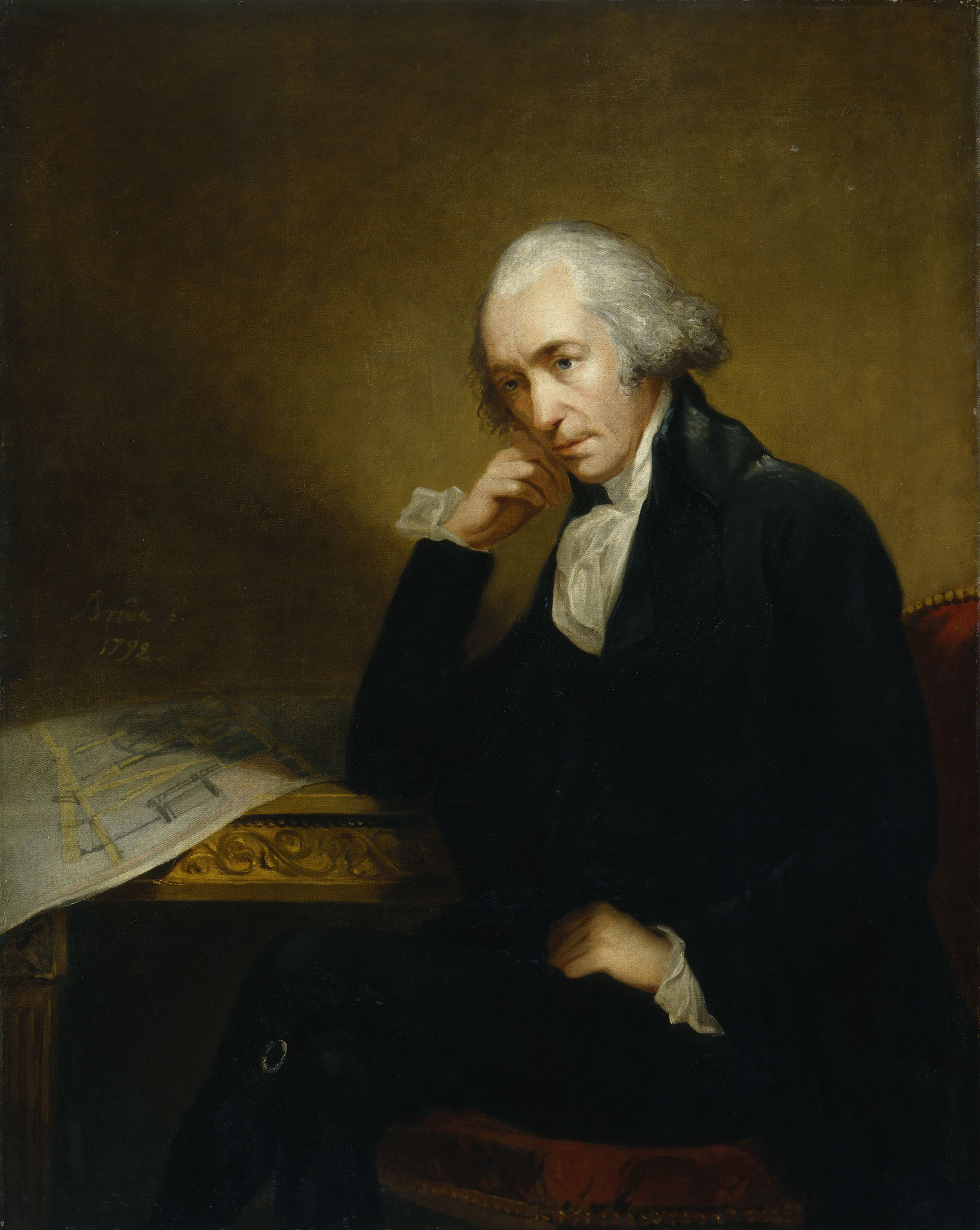
James Watt: The Engineer Who Perfected the Steam Engine
James Watt (1736-1819) was the Scottish instrument maker and inventor whose improvements to the steam engine made it the defining technology of the Industrial Revolution. By developing the separate condenser and a series of other innovations, Watt transformed the steam engine from a clumsy pumping machine into a reliable, efficient, and flexible source of power suitable for factories, mines, and transportation. His work not only changed the technology of his own time but laid the foundation for the entire industrial age.
Early Life and Training
Watt was born in Greenock, Scotland, in 1736, the son of a ship-owner and instrument maker. He showed an early aptitude for mathematics and engineering, and after a difficult apprenticeship in London, he returned to Scotland and eventually found work at the University of Glasgow, where he was employed to repair and maintain scientific instruments. Watt’s training as a craftsman, combined with access to the university’s scientific resources, gave him an unusual combination of theoretical and practical skills.
The defining moment of Watt’s career came in 1764, when he was asked to repair a model of a Newcomen steam engine belonging to the university. While working on the model, Watt became fascinated by the engine’s inefficient use of heat. He realized that the major source of waste was the repeated heating and cooling of the cylinder itself, and he began to experiment with ways to keep the cylinder hot while condensing the steam in a separate vessel.
The Separate Condenser
Watt’s solution, patented in 1769, was the separate condenser, a vessel kept cool by a surrounding water bath. Steam from the cylinder was allowed to enter the condenser, where it was rapidly cooled, creating a partial vacuum that drew the piston down. By keeping the cylinder hot, the new design dramatically reduced the fuel consumption of the engine.
Watt’s first full-scale engine, built in 1776 in partnership with the Birmingham manufacturer Matthew Boulton, demonstrated the new design’s superiority over the older Newcomen engines. Over the following decades, Watt continued to improve the engine, adding features such as the double-acting cylinder, the centrifugal governor, the pressure gauge, and the rotary motion gear. Each of these innovations increased the engine’s efficiency and usefulness.
Boulton and Watt
Watt’s partnership with Matthew Boulton, formed in 1775, was one of the most successful industrial partnerships in history. Boulton provided the capital, the manufacturing facilities at his Soho Manufactory in Birmingham, and the business acumen to market the new engines. Watt provided the technical genius. Together, they built and sold hundreds of engines over the next three decades, and the firm became the most important engineering company in the world.
The Boulton and Watt engines were expensive, but they saved their customers so much in fuel that they paid for themselves within a few years. The firm’s policy of charging customers a premium on the fuel savings of the engine, rather than a fixed price for the engine itself, was a novel arrangement that helped to make the new technology affordable to a wide range of users.
The Engine and Industry
Watt’s engines transformed British industry. By 1800, Watt’s designs were being used to power cotton mills, ironworks, flour mills, breweries, and a wide range of other factories. The introduction of the sun-and-planet gear, which converted the up-and-down motion of the piston into rotary motion, made the engine suitable for driving factory machinery through belts and shafts. The result was a fundamental shift in the location of industry, away from water-power sites and toward coalfields and cities.
Watt’s engines were also used in mining, where they replaced horses and human-powered pumps for lifting water and coal from underground. The application of steam to drainage was particularly important in the Cornish tin mines, where deep mines were threatened with flooding. The use of high-pressure steam engines, developed by Cornish engineers such as Richard Trevithick, eventually brought the Cornish mines back into production.
Watt’s Other Inventions
Watt was a prolific inventor beyond the steam engine. He developed the concept of horsepower as a way of comparing the output of his engines to the work of horses, and the term has remained in use ever since. He invented or improved a wide range of other devices, including a copying press, an indicator that traced the pressure of steam in an engine on a graph, and various measuring instruments. His indicator, in particular, was an important tool for the science of thermodynamics, which was being developed in the early nineteenth century.
Legacy
James Watt died in 1819 at the age of 83, by which time the steam engine was the dominant source of industrial power in Britain, and his name had become synonymous with the new industrial age. The watt, the unit of electrical power, is named after him, as is the Watt steam engine at the Science Museum in London, the world’s most famous preserved steam engine.
Watt’s importance goes beyond any particular invention. By demonstrating that a complex technology could be systematically improved through a combination of scientific theory and practical experiment, he helped to establish the modern idea of research and development. His partnership with Boulton, in which capital, manufacturing, and invention were combined in a single enterprise, was a model for the great industrial research laboratories of the late nineteenth and twentieth centuries.
The story of Watt’s improvements to the steam engine is also a reminder that even small improvements to existing technologies can have transformative effects. Watt did not invent the steam engine, but he made it efficient and useful, and the cumulative effect of his improvements was to change the world.
What It Teaches Us
The unresolved question about Watt is whether the conventional heroic-inventor account is the right one, or whether it is a 19th-century moral fable told in retrospect. The traditional answer, going back to Samuel Smiles’s Lives of Boulton and Watt (1865), is that Watt was a singular genius who combined theoretical knowledge (his friendship with Joseph Black and the latent-heat discovery) with practical engineering skill, and that the 1769 separate-condenser patent was the breakthrough on which the Industrial Revolution turned. The modern revisionist answer, developed in Richard Hills’s Power in the Industrial Revolution (1970) and given its most pointed form in Terry Reynolds’s Stronger than a Hundred Men (1983), is more cautious: the Newcomen engines of the 1730s and 1740s were already far more efficient than the standard textbook picture suggests, a substantial fraction of the fuel savings usually credited to Watt came from the Boulton and Watt shop in the 1790s, and the Cornish engineers of the 1810s and 1820s (running against Boulton and Watt royalty claims) achieved duty figures that the Boulton and Watt engines of 1800 could not match. The interesting current question, raised in Joel Mokyr’s A Culture of Growth (2016), is whether the Watt story is best read as a story about a man or about a community. The 19th-century reading was the man. The current reading, drawing on the cliometric work of Kanefsky and Robey, is closer to the community. The watt, the SI unit, will keep Watt’s name either way.
See also
See also
Selected Sources
- Jenny Uglow, The Lunar Men (2002).
- David P. Miller, James Watt, Chemist: Understanding the Origins of the Steam Age (2008).
- Richard L. Hills, Power from Steam (1989).
- Joel Mokyr, The Enlightened Economy (2009).